
Matrice 400 Field Report: Tracking Power Lines Across
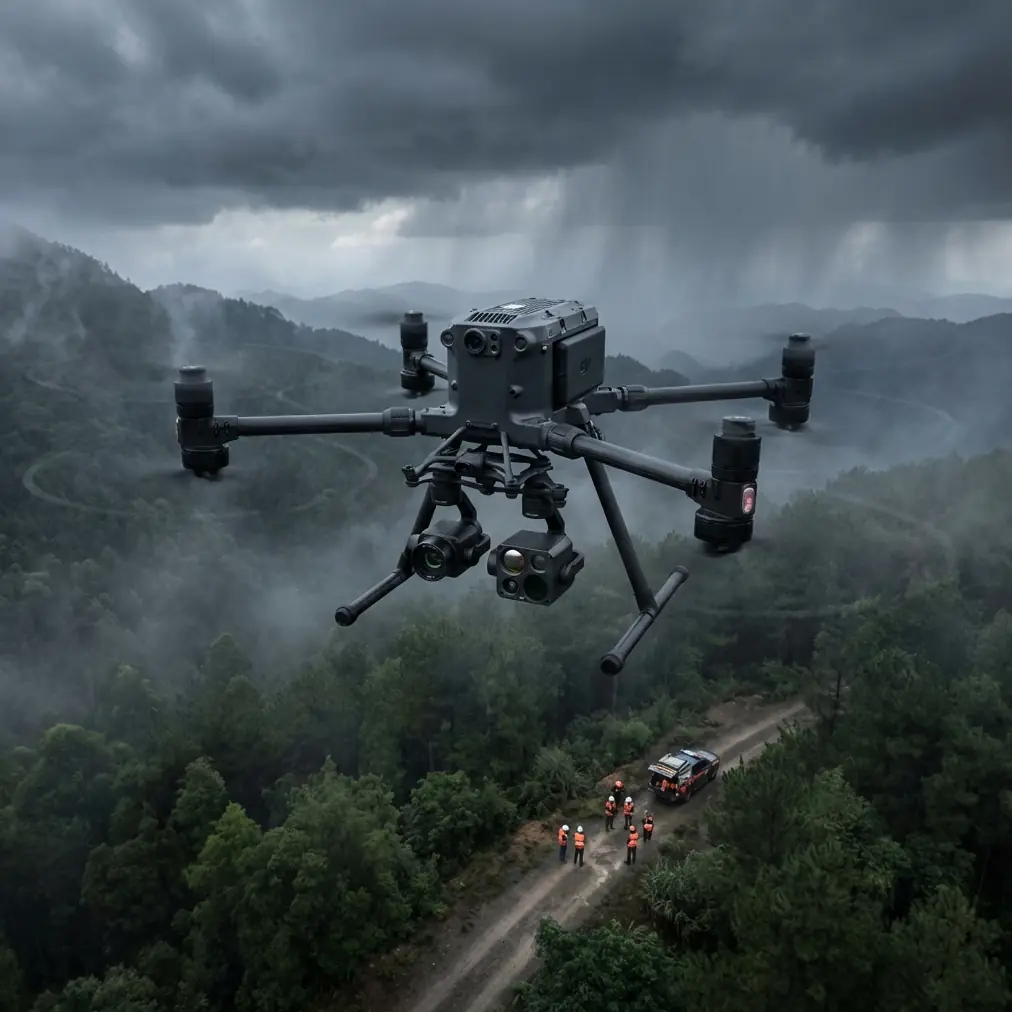
Matrice 400 Field Report: Tracking Power Lines Across Broken Terrain With Fewer Compromises
META: Expert field report on using the Matrice 400 for power line tracking in complex terrain, with practical insight on thermal imaging, O3 transmission, BVLOS readiness, hot-swap batteries, AES-256 security, and photogrammetry workflows.
Power line inspection looks straightforward on a map. In the field, it rarely is.
A transmission corridor that cuts across ridgelines, forest edges, river crossings, and access-poor slopes creates a flight problem long before it creates a data problem. The aircraft has to hold a reliable link where topography works against radio visibility. The payload has to reveal thermal signature anomalies without washing them out in midday heat. The mission plan has to keep moving even when battery swaps threaten to interrupt a critical section of line.
That is where the Matrice 400 starts to separate itself from lighter enterprise platforms and many mid-tier alternatives. Not because it solves everything automatically, but because it reduces the number of tradeoffs a utility team has to accept when the terrain gets ugly.
I have been looking at the Matrice 400 through one specific lens: tracking power lines in complex terrain where the mission is not simply “fly and film,” but identify defects, preserve positional accuracy, and maintain operational continuity over long corridors. In that context, a few features matter far more than spec-sheet trivia. O3 transmission matters. AES-256 matters. Hot-swap batteries matter. The ability to support both thermal work and photogrammetry-grade capture matters. And if your organization is preparing for BVLOS operations, the platform’s broader architecture matters even more than any single sensor.
Why power line tracking punishes weak aircraft choices
Utility inspection is one of the fastest ways to expose the difference between a drone that looks capable and one that stays dependable after the third hour in the field.
Power lines often run where roads do not. They cross gullies, contour around rock faces, and disappear behind tree cover and elevation changes that can challenge both pilot visibility and signal integrity. Add variable wind, changing sun angle, and the need to collect repeatable imagery on conductor condition, insulators, poles, towers, and surrounding vegetation, and the aircraft needs to do several jobs at once.
First, it must stay connected. In this environment, O3 transmission is not just a convenience feature. It directly affects whether a pilot can maintain stable control and video downlink while following a corridor that bends behind terrain. A weaker transmission system forces conservative stand-off, more repositioning, or more breaks in the inspection sequence. That costs time, but it also introduces gaps in the dataset. If you are tracing a fault path or documenting heat buildup on a section of hardware, broken continuity is not a minor annoyance. It can mean a return trip.
Second, the data needs to carry engineering value. Utilities are not collecting pretty footage. They are looking for signs that support maintenance decisions: abnormal connector temperatures, vegetation encroachment, damaged fittings, phase imbalance clues, and structural wear. Thermal signature interpretation is only useful when it is captured with context and consistency. A platform that can support thermal inspection while also feeding a photogrammetry workflow gives teams more than one angle on the same asset corridor.
Third, the mission cannot stall every time power runs low. Hot-swap batteries have real operational significance here. On a long transmission route, especially in uneven terrain where launch and recovery options are limited, keeping systems live during battery replacement helps preserve workflow momentum. That means less time reinitializing, less chance of losing mission continuity, and fewer small delays that add up across a full inspection day.
Where the Matrice 400 stands out against competitors
Competitors in the enterprise class often force you to choose which weakness you can tolerate.
Some offer respectable imaging but less confidence once terrain starts blocking line of sight. Others are compact and fast to deploy, but they become less convincing when the job requires longer corridor work, layered sensors, secure data handling, and a path toward more advanced operational approvals. The Matrice 400 feels built for teams that are tired of making that compromise.
The real edge is not one dramatic feature. It is the way the platform combines mission continuity, link stability, and enterprise-grade workflow compatibility into a package that fits infrastructure inspection unusually well.
Take O3 transmission. In power line tracking, this is one of the least glamorous and most decisive capabilities on the aircraft. A strong transmission backbone improves pilot confidence when terrain interrupts clean sightlines and when the aircraft needs to work at variable stand-off distances along the route. In practical terms, that means less hovering around to “make sure the feed comes back” and more deliberate capture of poles, conductors, insulators, and heat anomalies.
Then there is AES-256. On paper, security features are easy to overlook because they do not show up in the final orthomosaic or thermal report. In real utility environments, secure transmission and protected data workflows are not optional extras. Critical infrastructure operators increasingly have to think about who can access imagery, telemetry, and inspection records. AES-256 matters because it supports a more defensible chain of custody for operational data. If a drone is being used around substations, transmission routes, or sensitive grid assets, secure communications are part of the flight requirement, not a side note.
Compared with lighter competitors that are fine for occasional tower checks, the Matrice 400 also feels better aligned with repeat industrial deployment. That matters more than people admit. Utility work is repetitive by design. You want the same corridor documented in a way that supports comparison over time. You want teams to follow a consistent process. You want less improvisation. The Matrice 400’s mission-oriented design supports that discipline.
Thermal work is only useful if the aircraft supports the inspection logic
A common mistake in line inspection is treating thermal as a magic layer that automatically reveals every issue. It does not.
Thermal imagery only becomes actionable when the aircraft can hold stable framing, collect the right angle on the target, and preserve context for interpretation. A hot connector, warming splice, or overloaded component has to be seen in relation to neighboring hardware and environmental conditions. In steep terrain, that becomes harder because the aircraft is often compensating for slope, wind, changing background temperatures, and awkward approach angles.
This is where the Matrice 400’s broader flight and transmission profile helps. A steadier, more controlled approach improves the odds of capturing thermal data you can actually trust. If the pilot has to fight the link, re-stage position repeatedly, or rush each pass because battery state is driving the mission, the thermal layer becomes less diagnostic and more ambiguous.
For vegetation management near power lines, thermal can also help identify suspicious heating patterns where electrical issues may be developing before they trigger an outage. It is not a substitute for detailed electrical analysis, but it is a highly effective screening tool. The operational significance is speed: a drone crew can flag concerns early, prioritize ground intervention, and reduce the amount of blanket inspection effort spent on healthy assets.
Photogrammetry still matters for line corridors
Power line operators sometimes think of photogrammetry as secondary to thermal. That is a mistake, especially in complex terrain.
If your corridor crosses unstable slopes or dense vegetation, photogrammetry provides the spatial record that thermal alone cannot. It helps teams model tower locations, assess nearby encroachment, understand access constraints, and document terrain-driven risk around the line. When tied to GCP workflows, those outputs become more useful for engineering review, vegetation planning, and repeat inspection baselines.
The Matrice 400 makes sense here because it supports a more complete mission concept. You can inspect for immediate anomalies and also collect data that feeds terrain-aware asset management. GCP integration is not just a surveyor’s concern. In a corridor environment, better positional control means more confidence when comparing seasonal changes, mapping hazard trees, or aligning drone outputs with existing utility GIS layers.
That matters operationally. If a suspected issue appears near a tower on a steep hillside, a thermally interesting image is helpful. A geospatially reliable dataset that tells crews how the terrain, access path, structure location, and surrounding vegetation relate to that issue is far better. It turns a drone from a detection tool into a planning asset.
The battery question is bigger than endurance alone
People love to talk about flight time in abstract terms. Utility operators care more about what happens between flights.
Hot-swap batteries are one of those features that sounds incremental until you use them on a corridor job with limited daylight, narrow weather windows, and a sequence of priority structures to inspect. When the aircraft can remain mission-ready through battery replacement, the crew avoids the stop-start rhythm that breaks concentration and invites mistakes.
That benefit compounds over a full day. Less downtime means cleaner mission segmentation. Cleaner mission segmentation means better data continuity. Better continuity makes post-processing easier and helps analysts reconstruct the line without wondering what happened between sorties.
This is another area where the Matrice 400 holds an advantage over competitors that may be fine for short ad hoc flights but become inefficient during sustained industrial use. In infrastructure work, reducing friction around power management is not just about convenience. It protects the value of the whole inspection workflow.
BVLOS readiness changes the conversation
Many utilities are not fully operating BVLOS across all inspection programs yet, but a growing number are moving in that direction. Even if current flights remain within visual line of sight, procurement decisions increasingly reflect where operations will be in the next few years, not just where they are today.
That is why BVLOS should be part of the Matrice 400 discussion even when it is not part of today’s mission authorization. A platform built with enterprise communications, robust mission planning logic, secure data practices, and infrastructure-grade deployment expectations is easier to integrate into a future BVLOS roadmap than an aircraft chosen purely for short-term convenience.
For power line tracking in complex terrain, BVLOS relevance is obvious. Long corridors are exactly where extending operational reach can create major efficiency gains. The drone does not need to be flying BVLOS today for the team to benefit from choosing hardware that supports that operational maturity later.
This is also where the Matrice 400 compares favorably with competitors positioned as “good enough” utility tools. Good enough often becomes expensive once regulations, documentation standards, and scaling requirements become stricter. The Matrice 400 is better understood as a platform for organizations building a repeatable inspection program, not just buying another airframe.
A realistic field workflow with the Matrice 400
For a power line route through broken terrain, I would structure the mission in layers.
Start with corridor planning tied to known terrain obstacles, likely radio shadow zones, and priority assets. Build the route to preserve safe stand-off while still allowing high-confidence visual and thermal capture. If positional rigor matters for downstream modeling, establish GCPs where practical and align the mission output with your mapping requirements from the start rather than trying to retrofit accuracy later.
During flight, use the Matrice 400’s transmission strength as an operational buffer, not an excuse to get careless. The value of O3 is that it expands reliable control and downlink confidence in difficult terrain; the smart use case is to maintain disciplined flight geometry while reducing the interruptions that weaker platforms would create.
Capture thermal data with intent. Do not treat every warm spot as a defect. Compare components, note environmental factors, and preserve enough visual context to support engineering interpretation. Then collect overlapping imagery where photogrammetry can clarify terrain, vegetation, and structural conditions.
When batteries need changing, the hot-swap capability helps keep the mission coherent. That is not glamorous, but it is one of the reasons the dataset remains usable when the day is over.
If your team is refining this kind of workflow and wants to compare mission setups for corridor inspection, you can message an operations specialist here to talk through payload planning, flight logic, and data capture strategy.
Final assessment
The Matrice 400 is not the most interesting platform because of one headline spec. It is interesting because it aligns unusually well with the real demands of power line tracking in complex terrain.
O3 transmission improves mission continuity where hills, trees, and corridor geometry can sabotage weaker links. AES-256 supports the security expectations that come with inspecting critical infrastructure. Hot-swap batteries reduce downtime in long-field operations where continuity matters. And the ability to combine thermal signature analysis with photogrammetry and GCP-based mapping gives utility teams a more complete operational picture than a simple visual inspection ever could.
That combination is why the Matrice 400 looks stronger than many competitors in this particular job. Not lighter. Not flashier. Stronger where it counts: data quality, mission continuity, security, and scalability.
For utility operators responsible for line networks that cross difficult ground, that is the difference between a drone that occasionally helps and a platform that can anchor the inspection workflow.
Ready for your own Matrice 400? Contact our team for expert consultation.