
Matrice 400 Tracking Tips for Dusty Power Line Inspections
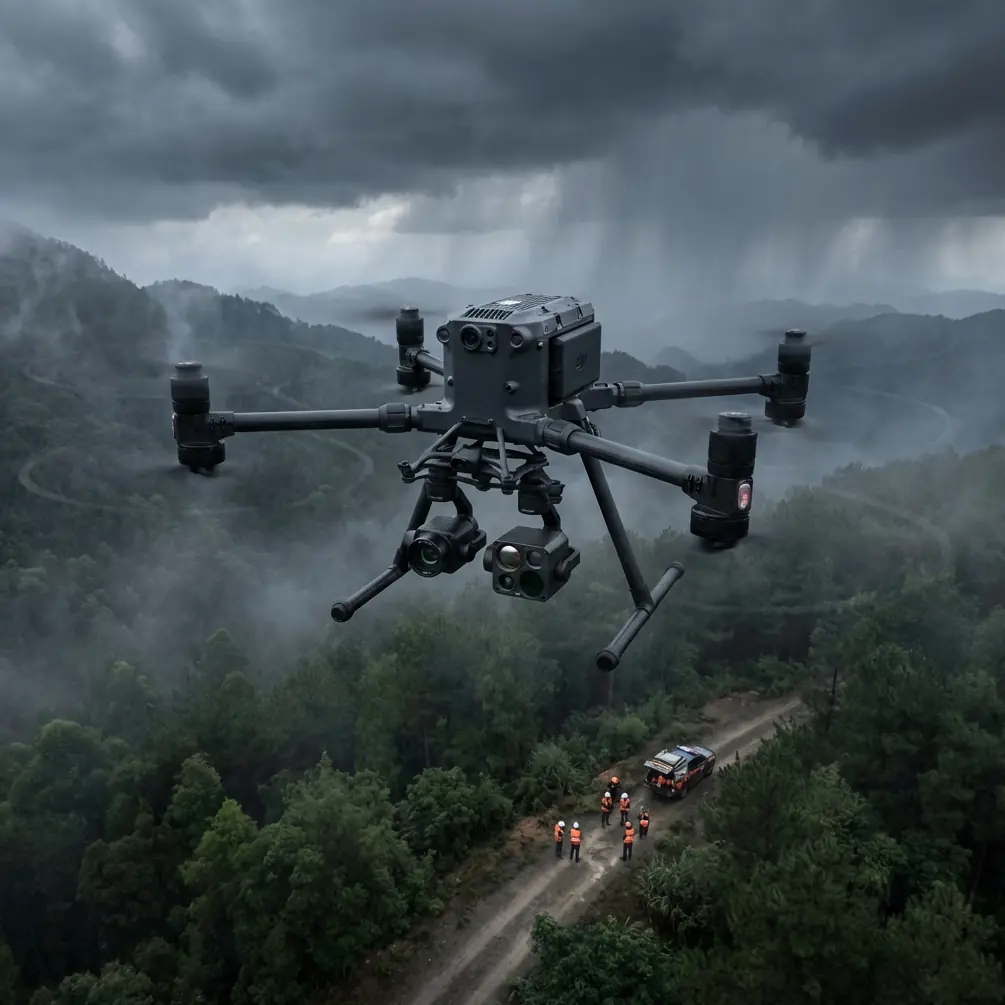
Matrice 400 Tracking Tips for Dusty Power Line Inspections
META: Expert Matrice 400 guidance for tracking power lines in dusty conditions, with practical advice on thermal workflows, O3 transmission, hot-swap batteries, AES-256 security, and BVLOS-ready field operations.
Dust changes everything on a power line job.
It softens contrast, hides fine hardware defects, interferes with visibility, and turns a routine corridor survey into a mission where setup matters as much as flight skill. If your assignment is to track transmission or distribution lines through dry, windblown terrain, the Matrice 400 stands out not because of one headline feature, but because its architecture fits the problem unusually well.
That distinction matters. Power line inspection is not a generic drone task. You are often flying linear assets over long distances, managing changing elevation, watching for vegetation encroachment, checking insulators and connectors, and trying to maintain clean data capture while the aircraft moves through a dirty atmosphere. The pilot needs stability. The payload operator needs trust in the image. The utility team needs usable output, not just flight logs and folders full of footage.
For that kind of work, the Matrice 400 deserves to be evaluated as an inspection platform rather than a spec-sheet trophy. In dusty power line environments, the real question is simple: can it keep the mission moving without compromising data quality, control link integrity, or operational discipline? In practice, the answer depends on how you build the workflow around its transmission, battery strategy, sensor stack, and security posture.
The real problem: dust degrades both eyesight and decision-making
When crews talk about dusty inspection routes, they usually start with image quality. That is only half the story.
Yes, suspended dust can flatten visual detail and make it harder to identify cracked caps, contamination buildup, damaged spacers, or strand issues. But the deeper issue is cognitive load. The more the air obscures the scene, the more the crew relies on telemetry confidence, sensor fusion, and repeatable flight behavior. A small uncertainty at the screen becomes a larger operational risk when the aircraft is following a corridor with poles, towers, guy wires, access roads, and occasional wildlife moving through the same space.
I have seen this firsthand on dry utility routes where a thermal pass looked clean until the visible payload told a different story. Dust had reduced the confidence of the visual read, while the heat signature still suggested a possible hotspot on a connector. That is exactly where a platform like the Matrice 400 earns its keep: not by replacing pilot judgment, but by giving crews multiple reliable ways to validate what they are seeing.
Thermal signature analysis is especially valuable in these conditions. Dust can obscure a technician’s confidence in standard optical inspection, but abnormal heating at connectors, clamps, and load-bearing components still tends to reveal itself when the thermal workflow is dialed in correctly. For line tracking, that means the aircraft is not just documenting asset position. It is helping the team separate harmless dust noise from faults that deserve a truck roll.
Why the Matrice 400 fits line tracking better than many crews expect
The Matrice 400 conversation often gets pulled toward headline capability. For utility work, that misses the point. The platform’s advantage is that several features combine into a very practical field system.
Take O3 transmission. On paper, transmission tech can sound abstract. In line inspection, it is operational oxygen. Dusty corridors often include terrain undulations, partial obstructions, and variable visual conditions that put extra pressure on the link between aircraft and crew. A strong O3 transmission environment helps preserve control confidence and video responsiveness when you need to make small, deliberate framing adjustments around hardware. That is not just a comfort feature. It affects whether you can safely hold standoff distance while still capturing actionable detail on conductors, insulators, and fittings.
Then there is AES-256. Security is easy to ignore until you are handling critical infrastructure data. Utility imagery is sensitive. Route maps, substation adjacency, hardware condition, and maintenance timing all have operational value. AES-256 matters because it helps ensure the data path and mission ecosystem are better aligned with the expectations of infrastructure operators who cannot treat inspection media like casual aerial content. In utility procurement and compliance discussions, security posture often influences whether a drone program scales or stalls.
Hot-swap batteries are another detail that reads small and performs large. Linear inspections punish downtime. If you have to break rhythm every time the aircraft needs power, you lose corridor continuity, crew focus, and sometimes weather windows. Hot-swap support reduces disruption during longer jobs and makes it easier to maintain structured inspection segments across successive flights. That is significant on dusty routes because the environment may only give you a narrow band of acceptable visibility before wind shifts or ground activity make conditions worse.
These are not glamorous details. They are the sort of details that decide whether a utility team finishes a corridor with clean, defensible data.
Dusty power line work is a sensor management exercise
A lot of drone operators approach line inspection as a flying problem. Experienced utility crews know it is really a sensing problem.
In dusty conditions, your visible payload, thermal payload, and mapping logic should support one another. The Matrice 400 becomes more valuable when you use it as a coordinated capture platform rather than as a simple camera carrier.
Start with thermal. If the mission objective includes identifying load anomalies, connector heating, or suspect components, thermal imaging should be used early enough in the workflow to flag areas that deserve a slower visual pass. Dust can mask surface detail, but thermal contrast often gives the operator a cleaner first clue about where the line is behaving abnormally.
Next comes photogrammetry, which is often underestimated in corridor work. Crews sometimes reserve photogrammetry for terrain or construction tasks, but it has a serious role in utility asset documentation. A structured photogrammetry pass can help create a usable spatial record of tower locations, conductor clearances, vegetation proximity, and route geometry. In dusty environments, that matters because repeatability is everything. If the air quality is inconsistent, you want a method that allows comparison across time rather than relying on memory and ad hoc camera work.
This is where GCP strategy enters the conversation. Ground control points are not always practical along every section of an active utility corridor, but where they can be deployed safely, they sharpen the reliability of mapped outputs. If the inspection program is tracking erosion near tower bases, access road changes, or vegetation growth threatening right-of-way clearance, GCP-supported photogrammetry can move the deliverable from “visually useful” to “engineering relevant.”
A corridor team using the Matrice 400 intelligently will often alternate between three modes of thinking:
- detect anomalies thermally,
- verify them visually,
- document the broader corridor condition through repeatable mapping.
That sequence is much stronger than trying to get every answer from a single sensor feed.
A wildlife moment that proves why sensor confidence matters
Not every obstacle on a line route is steel or ceramic.
On one dry inspection stretch, a red-tailed hawk lifted off from a crossarm and cut across the aircraft’s intended observation angle just as the crew was preparing to tighten framing on a suspect insulator set. It happened fast. Dust was already reducing scene clarity, and the bird’s movement could have forced a sloppy correction from an inexperienced crew.
What prevented that was not luck. It was disciplined stand-off, stable control response, and the ability to trust the aircraft’s sensing picture rather than chasing the shot. The operator backed off, held position, let the hawk clear the corridor, and resumed the pass without compressing distance around the structure.
That sort of encounter sounds anecdotal until you have spent enough time in field operations. Birds are part of the utility environment, especially near poles, towers, and open hunting ground. In dusty conditions, they are harder to anticipate visually. The lesson is straightforward: line inspections are rarely conducted in a sterile airspace. The Matrice 400 is at its best when crews use its platform stability and sensor workflow to preserve safe margins, even when wildlife appears exactly where you do not want it.
BVLOS readiness changes the planning conversation
For long utility corridors, BVLOS is never just a buzzword. It is a planning framework.
Even if a specific operation remains within visual line of sight today, many utility programs are designing procedures that can support more advanced corridor workflows tomorrow. The Matrice 400 belongs in that discussion because power line inspection naturally pushes teams toward longer, more structured route operations where efficient handoffs, persistent transmission quality, secure data handling, and battery continuity become decisive.
Dust reinforces the value of that mindset. If your route crosses broad, dry ground with little shade and variable visibility, repeated repositioning of crews can become inefficient and sometimes less safe than a more mature operational model. A platform that fits BVLOS-oriented planning encourages better route segmentation, clearer emergency procedures, stronger communications discipline, and more formalized data management.
That does not mean crews should overreach. It means they should build line inspection programs with the future in mind. A Matrice 400 deployment for dusty corridor tracking should be organized like a serious utility operation from day one, not a casual drone flight that happens to follow wires.
A practical field method for dusty line tracking
If I were building a repeatable Matrice 400 workflow for dusty power line inspections, I would use a problem-solution structure in the field, not just on paper.
The problem: dust reduces confidence, especially when the crew is moving quickly.
The solution: slow the mission down where it matters and standardize the sequence.
Begin with a route brief that identifies known interference risks, terrain transitions, wildlife activity, and the priority structures for close evaluation. Confirm communications expectations and define exactly when the pilot will break a pass due to visibility degradation rather than trying to “push through.”
Use the first segment to establish baseline visual conditions. If the visible feed is losing fine detail, do not wait for a maintenance analyst to discover it later in the office. Adjust the mission logic immediately. Shift more emphasis to thermal anomaly detection, widen stand-off where dust plumes are strongest, and reserve close visual confirmation for points where the aircraft can hold clean air and stable framing.
Plan battery transitions around corridor logic, not battery percentage alone. Hot-swap capability is most useful when it supports deliberate section breaks. End a segment at a natural inspection boundary, swap efficiently, verify payload status, and relaunch into the next section without scrambling the data organization.
Protect the data chain. AES-256 is not a footnote on critical infrastructure work. Build the mission folder structure, handoff process, and storage handling so the captured media remains controlled from aircraft to analyst.
Finally, maintain an escalation path. When thermal and visual findings disagree, flag the asset for a secondary review rather than forcing certainty in the field. That is often the difference between a professional inspection program and a rushed one.
If your crew is building out that kind of workflow and wants a second set of eyes on mission design, this quick utility drone planning line is useful: https://wa.me/example
What crews often get wrong with the Matrice 400 on utility jobs
The most common mistake is treating the platform as if better hardware automatically fixes poor inspection discipline.
It does not.
A strong aircraft still needs route logic, payload strategy, environmental thresholds, and post-processing standards. Another mistake is relying too heavily on optical imagery when dust is clearly degrading confidence. Utility teams that get the best results from the Matrice 400 are willing to let thermal findings drive the next step, rather than insisting on a single visual proof point under bad atmospheric conditions.
There is also a tendency to underrate mapping outputs in favor of dramatic close-up inspection clips. That is shortsighted. Photogrammetry, especially when supported with sensible GCP placement where appropriate, gives utilities a way to compare corridor condition over time. For vegetation management, structural context, and access planning, that broader record can be as valuable as a single defect image.
The bottom line for dusty corridor operations
The Matrice 400 makes the most sense on power line tracking missions when the environment is difficult and the operation is mature enough to use the aircraft properly.
Dusty inspections demand more than flight endurance or camera resolution. They demand transmission resilience through O3, secure handling through AES-256, battery continuity through hot-swap operations, and a sensor workflow that lets thermal, visual, and mapping outputs reinforce one another. Add BVLOS-oriented planning discipline, and the platform becomes far more than a drone following wires. It becomes a structured inspection system.
That is the difference utility operators should care about. Not whether the aircraft sounds advanced, but whether it helps crews make better decisions when the line disappears into glare, dust, heat shimmer, and the occasional hawk crossing the corridor at exactly the wrong moment.
Ready for your own Matrice 400? Contact our team for expert consultation.