
Matrice 400 for Solar Farms in Low Light
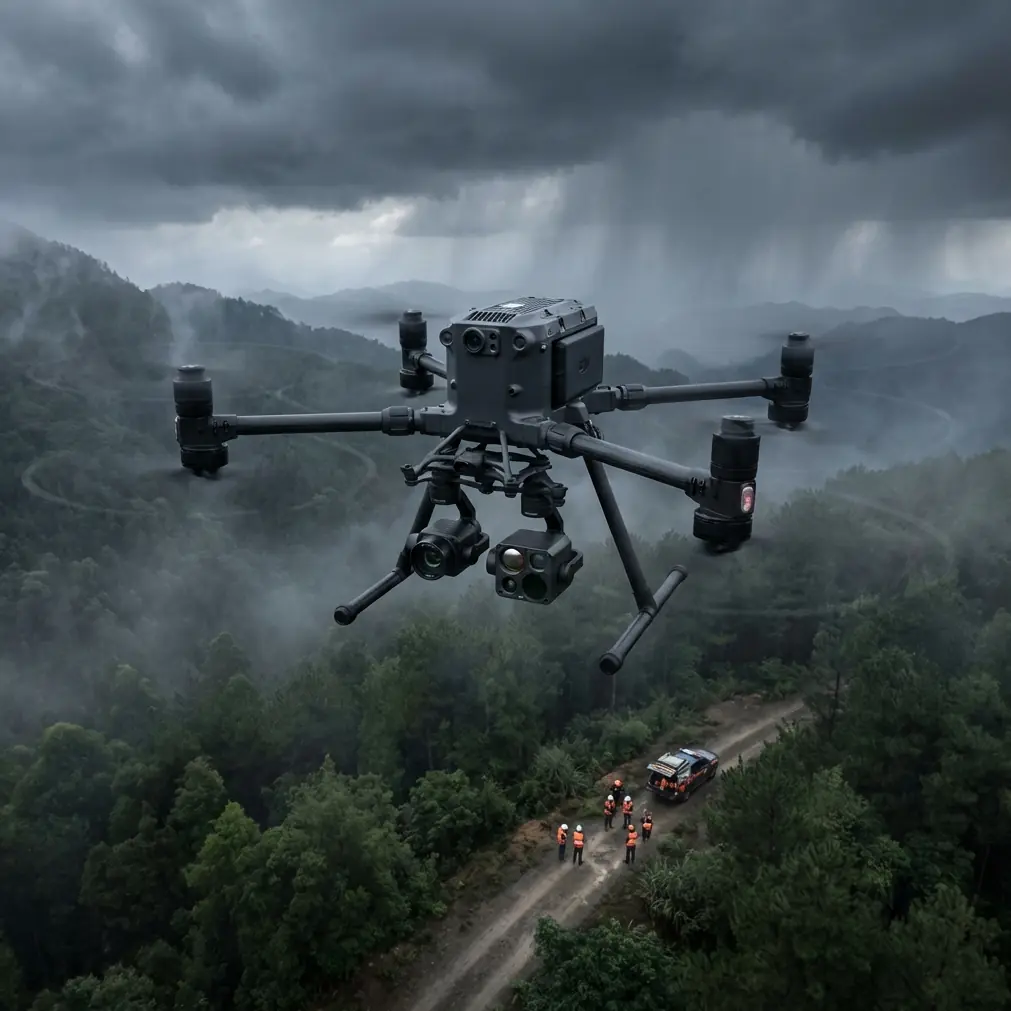
Matrice 400 for Solar Farms in Low Light: A Technical Review from an Operator’s Perspective
META: Expert review of the Matrice 400 for low-light solar farm operations, with practical insight on structural reliability, inspection workflow design, thermal signature capture, BVLOS readiness, and maintenance planning.
Solar farms create a strange kind of inspection problem. They are huge, repetitive, unforgiving, and often best checked when the sun is low or gone. That is exactly when thermal contrast becomes useful, and exactly when many aircraft begin to show their limitations. Low-light operations expose weak navigation confidence, unstable payload performance, short endurance under real mission loads, and poor workflow design long before a spec sheet does.
That is why the Matrice 400 deserves a more serious evaluation than the usual “bigger drone, more payload, longer flight” summary. For solar asset managers tracking thermal anomalies across sprawling PV fields, the more relevant question is simpler: does the platform stay accurate, stable, maintainable, and operationally efficient when the inspection window is narrow and the site is vast?
My view is yes—but not for the shallow reasons people usually cite.
Why low-light solar work is harder than it looks
A daytime drone survey of a solar plant is easy to explain and easy to misunderstand. If the goal is photogrammetry, visible-light mapping can be scheduled with plenty of flexibility. If the goal is thermal fault detection, the timing gets tighter. String faults, cell damage, connector heating, diode issues, soiling patterns, and emerging hotspots can all depend on thermal contrast conditions that don’t wait around for your operations team to get organized.
This is where aircraft architecture matters. Not just camera quality. The drone has to carry the right sensor suite, maintain link stability across long rows, hold predictable flight characteristics near changing terrain and infrastructure, and turn flights around without creating dead time between sorties. On solar farms, dead time is expensive in a way many pilots underestimate. The site is still there, the weather is still moving, and the thermal profile is already changing.
The Matrice 400 fits this mission profile well because it supports more than one operational style. It can be configured for thermal inspection passes, visible-light verification, and mapping support in the same program rather than forcing operators to maintain separate aircraft classes for each job.
The real advantage is not one feature. It is system behavior.
A lot of competing enterprise drones can perform pieces of this job. Some are lightweight and easy to move. Some are excellent camera carriers. Some have respectable obstacle sensing or decent transmission. But solar farm inspections in low light reward consistency across the whole stack.
That includes:
- stable thermal signature acquisition
- dependable O3 transmission over long linear routes
- secure data handling with AES-256
- battery strategy that keeps crews moving
- support for BVLOS-oriented planning where regulations permit
- enough payload and mission flexibility to bridge thermal inspection and photogrammetry workflows
This is where the Matrice 400 starts to separate itself. It is not just “capable.” It is better suited to operations where the job is constrained by time, darkness, distance, and repeatability all at once.
Low-light thermal work lives or dies on repeatability
Let’s start with the mission itself. When you’re tracking a thermal signature across thousands of modules, the issue is not merely whether the camera sees heat. The issue is whether the platform helps you reproduce the same quality of capture, row after row, site after site, inspection cycle after inspection cycle.
That repeatability has a lot to do with airframe discipline. One of the more interesting ideas hidden in the reference material comes from classical aircraft structural design: load paths and failure stress are not treated as single-pass values. In the design handbook excerpt, the structural calculation process is iterative. The engineer calculates an effective skin width, determines a new failure stress, recalculates section behavior, and repeats the process until the difference meets accuracy requirements. That loop matters conceptually for how we should judge a serious industrial UAV.
A platform intended for commercial inspection should not be built around one optimistic number. It should be built around convergence—load, stiffness, and usable structural margin working together until the aircraft behaves predictably under mission stress. The source even points to a specific treatment detail: in a double-row rivet-line condition, the flange thickness tied to the skin is taken as 3/4 of the sum of the flange and skin thicknesses for that local evaluation. That is not trivia. It reflects the kind of engineering discipline required when structural interaction affects real-world strength and compression behavior.
For a Matrice 400 operator, the operational significance is straightforward. When you are flying low-light thermal sorties with heavier sensors, changing winds, repeated takeoff cycles, and long-duration route work, you benefit from an aircraft class that belongs in a more serious structural conversation than a light prosumer machine. You may never calculate effective skin width in the field, but you absolutely feel the difference when the aircraft tracks cleanly and carries payloads without becoming twitchy, compromised, or maintenance-prone.
Transmission matters more on solar farms than in most inspection sectors
Linear missions over utility-scale arrays are a brutal test of link quality. Every turn, every inverter station, every terrain ripple, and every block of infrastructure can become a nuisance if your control and video pipeline is marginal.
This is one reason O3 transmission is a meaningful keyword here, not just a brochure term. On a large solar site, operators often need to review thermal anomalies in real time while maintaining confidence in route continuity. A strong transmission system reduces the temptation to overfly manually, second-guess autonomous execution, or bring the aircraft back early because the pilot no longer trusts what they’re seeing.
Against many competitors, this is where the Matrice 400 can excel. Some platforms look fine in nominal open-field demos but begin to feel fragile once the mission stretches in both distance and duration. A robust transmission stack keeps the aircraft useful at the exact moment the site stops being convenient.
For operators planning toward BVLOS frameworks, this becomes even more important. I’m not suggesting anyone bypass local rules. The point is that a platform chosen today should still make sense as operations mature tomorrow. If your organization expects to pursue larger perimeter routes, recurring corridor-like inspections, or distributed asset monitoring under more advanced approvals, transmission reliability is not optional. It is part of the business case.
Thermal plus photogrammetry is where the Matrice 400 gets interesting
Many solar teams still separate thermal inspection from mapping logic. That creates handoff friction. The thermal crew finds anomalies. The survey crew later builds context. The maintenance team then tries to reconcile findings with layout references, row labels, and asset IDs.
A better model combines thermal collection with mapping discipline. Use thermal signature detection to identify suspect modules, then support remediation and verification with photogrammetry-grade context. This is where GCP strategy still matters. Ground control points may seem old-fashioned in an RTK-heavy era, but on large, repetitive sites they remain valuable for tying outputs to maintenance records and ensuring confidence in comparison datasets over time.
The Matrice 400 is well positioned for this mixed role because it is not trapped in a single-sensor mindset. For solar operators, that means one aircraft program can support:
- low-light thermal anomaly detection
- daytime visible orthomosaics
- targeted engineering inspections
- repeatable documentation for warranty or O&M workflows
That consolidation is practical, not theoretical. Fewer aircraft types usually mean simpler training, cleaner battery logistics, more consistent SOPs, and less confusion in the field.
Maintenance planning is an underrated reason to favor a serious platform
Most drone reviews focus on first-flight capability. Commercial operators should spend more time on the 50th, 150th, and 500th mission.
The second reference document, despite coming from manned aviation support planning, contains a useful operational lesson. It describes maintenance as a layered program rather than a single event: light routine checks, intermediate checks, more detailed “C” level inspections, and structural inspection planning distributed across the fleet. It even gives a concrete sampling example: for one fleet model, 1/4 of aircraft complete structural inspection at 14,000 flight hours, another 1/4 at 28,000, another at 42,000, and the final 1/4 at 56,000, then the cycle repeats. In another example, a 4-aircraft Boeing 727 fleet with a 12,000-flight-hour structural inspection interval can stagger inspections at 12,000, 24,000, 36,000, and 48,000 hours.
Why bring that into a Matrice 400 review? Because solar operations scale poorly when maintenance is reactive. If you are running multiple crews or multiple sites, the aircraft should fit into a planned support rhythm. The large-aircraft lesson is to distribute downtime intelligently, not wait for major service bottlenecks.
Operationally, that means the Matrice 400 makes more sense when paired with a disciplined program:
- pre-flight visual walkaround equivalents
- periodic payload mount and landing gear inspection
- structured battery health tracking
- planned motor and arm checks
- fleet staggering so not every aircraft enters heavy service at the same time
Hot-swap batteries become more meaningful in this context. Their value is not just faster turnaround. Their real value is smoother fleet tempo. On a cold early-morning thermal mission, every minute saved between launches preserves the inspection window. If your site is large enough, one slow battery workflow can erase the advantage of a good thermal sensor.
Security is not an abstract issue for energy infrastructure
Solar operators and EPC teams increasingly care about who can access site imagery, plant layouts, and inspection data. AES-256 matters here because energy infrastructure datasets are operationally sensitive even when they are not classified. Thermal maps can reveal failure patterns, maintenance schedules, and equipment concentration. Orthomosaics can expose perimeter design and infrastructure locations.
The Matrice 400’s suitability for this environment improves when secure transmission and disciplined data handling are treated as part of the mission design, not a compliance afterthought.
That also affects contractor selection. If you are outsourcing flights, ask how data is encrypted, where it is stored, and how anomaly records are passed into maintenance systems. If you need to talk through a solar-specific workflow before defining your inspection program, this quick technical chat channel is a practical place to start.
Where competitors usually fall short
The common failure mode in competing platforms is imbalance.
One drone may have decent thermal capability but weak endurance under real payload conditions. Another may fly long enough but feel compromised in low-light navigation confidence. Another may be portable and inexpensive to deploy but lacks the systems depth for repeated utility-scale operations. Some simply become inefficient once you try to combine thermal inspection, documentation, and mapping in one operational framework.
The Matrice 400’s edge is that it feels designed for organizations, not hobby-grade field improvisation. For solar farms, that distinction matters. The mission is repetitive, but the risk is cumulative. Every weak point in your aircraft program becomes visible eventually: patchy links, awkward battery swaps, fragile support practices, inconsistent outputs, or poor data security.
My verdict for solar farm work
If your use case is low-light monitoring across large PV assets, the Matrice 400 stands out less because of headline specs and more because it supports a mature inspection system.
It suits teams that think in terms of:
- repeatable thermal anomaly capture
- secure long-range operations
- BVLOS-ready planning pathways
- integrated photogrammetry with GCP discipline
- planned maintenance instead of reactive downtime
- fast launch cycles built around hot-swap battery workflows
That last part is what many buyers miss. The best drone for solar work is not the one that looks strongest in a single isolated flight. It is the one that still works elegantly when the operation becomes boring, frequent, large, and accountable.
The old aircraft engineering references behind this discussion make that point surprisingly well. Structural strength is solved iteratively until the result converges. Fleet support is staged so inspections do not cripple operations. Those are not relics from another era. They are exactly the right principles for evaluating a modern industrial UAV.
The Matrice 400 earns its place when judged by those standards.
Ready for your own Matrice 400? Contact our team for expert consultation.