
Matrice 400 Field Report: Tracking Urban Venues With More
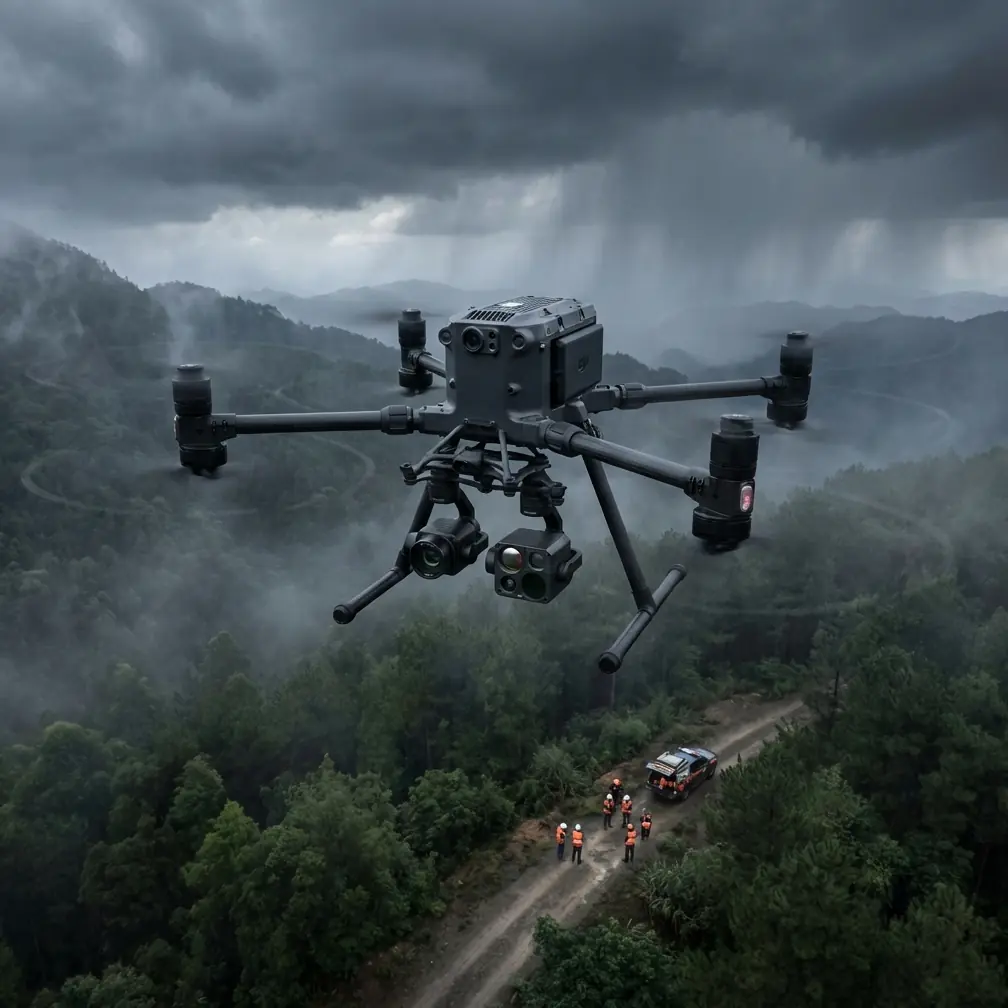
Matrice 400 Field Report: Tracking Urban Venues With More Confidence and Less Guesswork
META: Expert field report on using the DJI Matrice 400 for urban venue tracking, with practical insights on O3 transmission, AES-256 security, thermal workflows, hot-swap batteries, photogrammetry, GCP setup, and BVLOS-ready operations.
Urban venue tracking sounds straightforward until the aircraft is actually in the air. Stadium roofs distort line of sight. Glass towers throw multipath interference back at the radio link. Narrow service corridors create dead zones for visual reacquisition. Then there is the job itself: maintaining awareness around entrances, perimeters, rooftops, loading areas, and temporary structures without breaking the rhythm of an event day.
That is the operating context where the Matrice 400 starts to make real sense.
This is not a generic platform story. It is a field report built around a very specific mission profile: tracking venues in dense urban areas where radio reliability, image continuity, battery logistics, and data security matter as much as raw flight performance. If you are planning overwatch for arenas, convention centers, festival grounds, transit-adjacent venues, or mixed-use complexes, the Matrice 400 stands out less because of a single headline feature and more because of how its systems work together under pressure.
As Dr. Lisa Wang would put it, urban drone work rarely fails because of one dramatic limitation. It fails because small constraints pile up. The best aircraft is the one that removes several of those constraints at once.
Why Urban Venue Tracking Is Harder Than It Looks
A venue in a city is not just a building. It is a changing operational envelope.
One hour before gates open, the priority may be mapping choke points and validating temporary fencing. During ingress, the task shifts toward crowd flow, rooftop monitoring, and detecting heat anomalies around utility infrastructure. After dark, thermal signature analysis becomes more valuable, especially for spotting unauthorized rooftop access, loitering near service entrances, or equipment overheating behind structures that standard RGB imagery cannot read clearly.
The challenge is continuity. You need stable transmission as the aircraft moves around reinforced concrete, metal structures, and RF noise. You need enough endurance to avoid awkward mission breaks. You need secure data handling if the operation involves private security, public agencies, or sensitive site layouts. And if the mission expands beyond direct visual comfort zones, your procedures must align with BVLOS-oriented workflows even when the specific regulatory envelope varies by location.
This is exactly where the Matrice 400 separates itself from many competitor-class aircraft that can produce good footage but struggle to support a disciplined urban operations stack.
O3 Transmission Is More Than a Spec Sheet Talking Point
For venue tracking, transmission quality is operational quality.
The Matrice 400’s use of O3 transmission matters because urban environments punish weak links. On paper, many platforms promise strong image feeds. In practice, venue monitoring often means flying beside reflective facades, around grandstands, over loading bays, and across service alleys where signal integrity can degrade quickly. O3 gives operators a more resilient control and video backbone for these signal-hostile conditions.
That has a direct effect on decision-making speed. If your pilot and payload operator are dealing with intermittent lag or image breakup while trying to confirm movement along a roofline or follow a vehicle through a service perimeter, the mission slows down. Worse, confidence drops. Every hesitant input creates a cascade: slower repositioning, more conservative standoff distances, more battery used, and less usable time on target.
Compared with lighter enterprise drones or older transmission stacks, the Matrice 400 is simply better suited to keeping an urban venue mission coherent when the geometry of the site starts working against you. That advantage is easy to underestimate until you are trying to maintain eyes on a moving subject between a steel canopy and a concrete parking structure.
AES-256 Security Has Real Relevance for Venue Operations
Security language often gets flattened into marketing copy. That is a mistake.
AES-256 matters on the Matrice 400 because venue tracking frequently intersects with sensitive operational information: access routes, law enforcement staging, executive entry points, back-of-house logistics, utility vulnerabilities, and crowd management patterns. This is not abstract. A detailed aerial record of a high-profile urban site can expose more than the client intended if workflows are careless.
A secure transmission and data environment reduces risk when multiple stakeholders are involved. Private security teams, municipal agencies, venue operators, and production managers often need visibility into the same mission, but not every piece of collected data should circulate loosely. With AES-256 in the stack, the Matrice 400 aligns better with the expectations of organizations that treat aerial data as operational intelligence rather than just imagery.
That is another area where the platform compares favorably to lower-tier systems. Some drones can capture an acceptable visual product, but the Matrice 400 better fits organizations that need technical assurance around the chain of custody for video and mission data.
Hot-Swap Batteries Change the Tempo of the Day
Urban venue tracking is full of inconvenient timing. Flights rarely end when the venue becomes less relevant. They end when batteries do.
That is why hot-swap batteries deserve more attention than they usually get. On the Matrice 400, hot-swapping is not a comfort feature. It is a tempo feature. It allows crews to keep the aircraft ready without lengthy turnaround interruptions, which is especially useful when a site transitions through multiple operational phases in a single shift.
Consider a day at a downtown stadium. Pre-event inspection starts in daylight with RGB capture for photogrammetry and roofline documentation. Midday brings service access monitoring and loading dock oversight. Evening introduces crowd movement and thermal sweeps of adjacent structures. You do not want to rebuild the mission rhythm from scratch after every battery cycle.
The practical significance is simple: faster battery transitions preserve crew concentration and preserve mission continuity. That can be the difference between catching an emerging issue near a restricted service lane and relaunching too late to reconstruct what happened.
Competing systems often force crews into a stop-start cadence that is tolerable on a rural inspection job but frustrating in a live urban venue environment. The Matrice 400 is better matched to operations where the clock, not the aircraft, should set the pace.
Thermal Signature Work Is Where Venue Tracking Gets Smarter
Urban venue surveillance without thermal is often a partial picture.
Thermal signature analysis becomes especially valuable at night, during bad weather, or in cluttered back-of-house zones where visual contrast is poor. Around venues, heat can reveal occupancy, equipment stress, concealed activity, or unusual movement patterns. A rooftop mechanical zone that appears quiet in standard imagery may show a localized thermal anomaly. A person sheltering near ductwork or behind service infrastructure is easier to distinguish when heat separates the subject from the background.
For the Matrice 400, the key point is not just that it can support thermal-capable workflows, but that it does so in a platform stable enough for systematic urban operations. That stability matters when you are correlating thermal observations with visible-spectrum imagery and geospatial references. A thermal hit is useful. A thermal hit that can be quickly rechecked, repositioned, and tied to an exact section of the venue is much more useful.
This is one reason security teams and facility operators often prefer a larger enterprise aircraft to smaller alternatives. The Matrice 400 is not trying to be the most casual deployment option. It is trying to be the one that holds up when the mission gets layered.
Photogrammetry and GCPs Are Not Just for Construction Maps
One of the more overlooked advantages of using the Matrice 400 around urban venues is its role in pre-event and post-event photogrammetry.
Many operators still treat venue tracking as a live-video task only. That leaves value on the table. A properly planned photogrammetry mission, anchored with GCPs, can give venue teams an updated spatial model of temporary barriers, parking layouts, merchandise zones, staging compounds, emergency corridors, and pedestrian routing changes. In a city, where curb use and neighboring properties complicate movement, those details matter.
GCPs are especially important if the site team wants repeatable measurement accuracy rather than just a visually pleasing map. A venue operator comparing layouts across multiple event weekends needs consistency. They want to know whether a fenced queue lane shifted, whether a temporary structure encroached on an emergency path, or whether the spacing between bollards and crowd-control barriers still meets the operational plan.
The Matrice 400 excels here because it can bridge both sides of the mission: live situational awareness and structured geospatial capture. Some competitor platforms are fine as eyes in the sky but less convincing as data-collection tools for repeatable operational mapping. That dual capability makes this aircraft more valuable over the life of a venue program, not just during a single flight window.
BVLOS Readiness Is About Procedure, Not Posturing
BVLOS gets mentioned casually, but urban use demands discipline.
Whether a given mission is legally flown beyond visual line of sight depends on the local regulatory environment and approvals. Still, the Matrice 400 is a strong fit for BVLOS-oriented planning because its combination of transmission reliability, encrypted communications, enterprise workflow support, and sustained operational tempo lends itself to more mature remote operations frameworks.
That matters even for teams still operating strictly within visual line of sight. Why? Because designing a venue tracking program with BVLOS-grade habits usually improves safety and consistency overall. Better route planning. Stronger lost-link procedures. Clearer observer positioning. Tighter geofencing logic. More disciplined communication between pilot, payload operator, and ground coordinators.
In other words, the Matrice 400 supports a higher standard of operation. The aircraft does not replace regulatory process, but it gives serious teams a platform worth building that process around.
Where the Matrice 400 Beats Competitors in Real Urban Use
Competitor comparisons often focus on isolated metrics. That misses the point.
For urban venue tracking, the Matrice 400’s edge is cumulative. O3 transmission helps retain control and visual continuity in difficult RF conditions. AES-256 supports secure handling of sensitive site data. Hot-swap batteries reduce dead time during long operational windows. Thermal workflows improve detection when visible imagery falls short. Photogrammetry and GCP-supported mapping turn flights into documented spatial intelligence instead of disposable video.
Many alternative enterprise drones can do one or two of these things well enough. Fewer combine them in a way that makes a venue team more effective over a full operating cycle.
That is why the platform is particularly strong for urban venues. Not because it looks impressive on deployment, but because it reduces friction across the actual chain of work: launch, monitor, detect, verify, document, and hand off.
A Practical Mission Framework for Urban Venue Teams
If I were building a Matrice 400 workflow for a city venue, I would break it into four layers.
First, establish a daylight photogrammetry baseline using planned ground control points. This creates a current spatial reference for entrances, barriers, rooftop assets, and temporary installations.
Second, run focused perimeter and rooftop sweeps during setup windows, using the aircraft’s transmission reliability to maintain clean observation around signal-obstructed sectors.
Third, shift to live overwatch during ingress and event operation, prioritizing loading areas, service corridors, roof access points, and traffic interfaces around the venue edge.
Fourth, schedule thermal checks during low-light periods to identify heat anomalies and concealed activity that RGB monitoring may miss.
The Matrice 400 is unusually good at supporting this layered approach because it does not force a hard choice between mapping aircraft and security aircraft. It can do both jobs within the same program, which simplifies training, maintenance, and SOP development.
If your team is refining that kind of workflow, a quick message through our urban UAV operations desk can help pressure-test the mission design before deployment.
Final Assessment
The Matrice 400 makes the most sense in urban venue tracking when the mission is treated as an operational system rather than a simple aerial camera task. Its value shows up in the spaces between the obvious features: smoother continuity between flights, stronger link confidence near difficult structures, better handling of sensitive data, and a more credible path toward advanced operating practices.
That is why it stands above many competitors in this role. Not because it promises everything, but because it addresses the actual failure points that urban crews run into week after week.
For venue teams working around stadium districts, entertainment corridors, convention centers, or multi-building event campuses, that distinction is not minor. It is the difference between having footage and having a reliable aerial capability.
Ready for your own Matrice 400? Contact our team for expert consultation.