
Matrice 400 Low-Light Venue Tracking: Antenna Setup
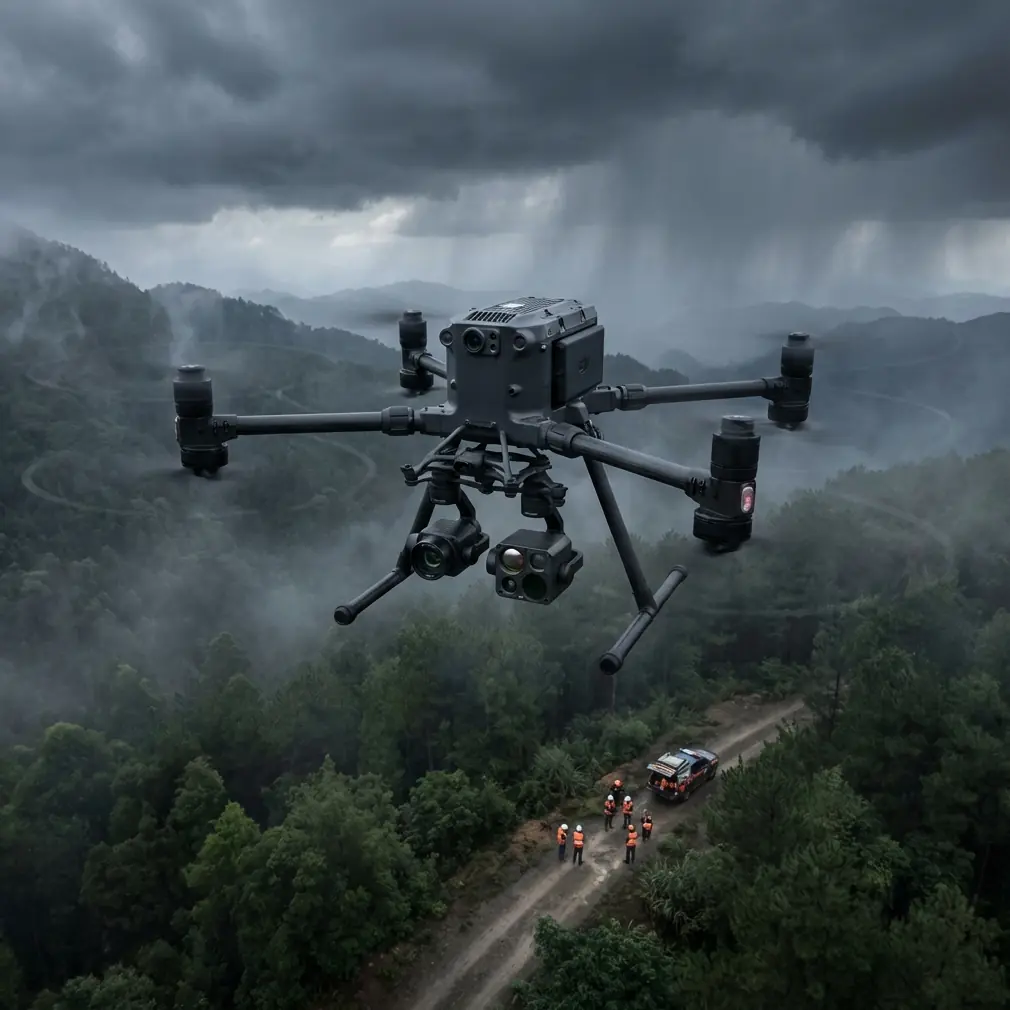
Matrice 400 Low-Light Venue Tracking: Antenna Setup, Thermal Workflow, and Flight Discipline
META: Expert tutorial on using the Matrice 400 for low-light venue tracking, with practical advice on antenna positioning, thermal signature capture, O3 transmission reliability, AES-256 security, hot-swap battery planning, and BVLOS-ready workflow design.
Low-light venue tracking is where drone capability stops being about headline specs and starts being about discipline. The Matrice 400 is a serious platform, but at dusk, under patchy floodlights, around reflective roofs, scaffold, steel truss, and temporary structures, even a capable aircraft can be held back by poor setup. What matters is not simply getting airborne. What matters is maintaining a stable visual and data picture when contrast is weak, shadows are deceptive, and the target moves through clutter.
If your job is tracking activity around stadiums, concert grounds, fairgrounds, race facilities, or other large venues after sunset, the Matrice 400 gives you a strong foundation. The real advantage comes from how you configure the mission before takeoff and how you interpret what the aircraft is telling you in flight.
This tutorial is built around one scenario: tracking venues in low light with the Matrice 400 while preserving link quality, thermal clarity, and operational continuity. I’ll focus on the details that actually change outcomes in the field, including thermal signature management, antenna positioning for maximum range, battery strategy, secure data handling, and when photogrammetry and GCP planning still matter even during a surveillance-oriented mission.
Why low-light venue tracking is difficult
Large venues produce a messy sensor environment. Lighting is uneven. Bright signage can wash out nearby detail. Parking lots cool at a different rate than concrete concourses. HVAC exhaust, portable generators, catering trucks, and dense groups of people all create overlapping thermal signatures. Add fencing, metal seating, broadcast rigs, and temporary event infrastructure, and you have multiple sources of signal reflection and target confusion.
That is why low-light tracking should never be treated as a simple nighttime version of a daytime mission. The cues change. Color detail becomes less reliable. Depth perception degrades. Motion can be easier to detect than identity. In many cases, thermal contrast becomes more useful than visible contrast, but only if you understand what the sensor is actually showing you.
The Matrice 400 is especially relevant here because a venue mission often stretches longer than expected. Security teams may need persistent overwatch across ingress, event operation, and egress. Continuity matters. So does maintaining a secure control link when you are operating around crowded RF conditions.
Start with the right tracking logic, not just the right camera
A common mistake in low-light venue work is trying to identify first and track second. That sequence is often backwards.
At night, you typically detect with thermal and confirm with visible payload data when conditions allow. A moving thermal signature crossing a dim service road or slipping behind a stage structure may be easier to follow than the same target in a noisy RGB scene. The visible camera then becomes a verification tool when lighting or angle improves.
This changes how you fly. Instead of pushing the aircraft lower to “see better,” you often maintain a cleaner geometry from higher altitude, preserve a wider field of regard, and let movement and heat separation do the work. In practical terms, that reduces the chance of losing the subject behind lighting towers or rooflines.
Operationally, that also means the Matrice 400’s link stability becomes central. A short hesitation in video downlink can cause an operator to lose continuity on a target that is visible for only a few seconds between structures.
Antenna positioning advice for maximum range
This is where many otherwise solid crews give away performance. The aircraft may be excellent, but the control link is only as clean as the operator’s antenna discipline.
If you want maximum practical range and a steadier connection around large venues, the first rule is simple: do not point the flat face or tip of the antenna directly at the aircraft unless the system specifically calls for that geometry. Most operators get better results by orienting the antenna elements so their broad radiation pattern covers the aircraft’s flight path, while keeping the remote controller itself clear of the body, vehicle roofs, barricades, and metal railings.
A few field-tested habits matter:
- Stand elevated if possible, even by a small amount. A control position on a platform, berm, or upper service lane can improve line-of-sight dramatically.
- Keep your own body from blocking the signal path. Turning your torso the wrong way can reduce link quality more than many pilots expect.
- Avoid operating immediately beside steel fencing, production trucks, scaffolding, or grandstand understructures. These surfaces can create multipath reflection and make the link behave inconsistently.
- Track the aircraft with deliberate controller orientation as it moves laterally. Do not set the antennas once and forget them.
- If the mission requires long corridor coverage around a venue perimeter, position the pilot where the aircraft will spend the majority of the flight, not where takeoff happens to be most convenient.
This is especially relevant when relying on O3 transmission in a complex RF environment. At a busy venue, you may be competing with Wi-Fi saturation, media equipment, wireless comms, and temporary network infrastructure. O3 transmission is valuable because it is designed for robust downlink performance, but it still rewards good geometry. The system is not a substitute for line-of-sight discipline. It is a multiplier when that discipline is already in place.
In practice, a crew that pays attention to antenna angle and pilot placement often sees a more stable live view, fewer abrupt drops in image quality, and more confidence in tracking targets through dead-ground transitions. Those gains are operational, not cosmetic.
Thermal signature reading: what the scene is really telling you
Thermal is not magic. It is context.
At venues in low light, the most useful thermal observations often come from contrast, not absolute heat. A person crossing an open asphalt lot may stand out strongly early in the evening, then blend more as the surface cools unevenly. A vehicle that has recently parked can remain thermally obvious long after motion stops. Security staff near lighting generators may be harder to isolate than someone moving along a darker service boundary.
That means you should build your search logic around environmental categories:
- Open paved areas
- Rooflines and mechanical zones
- Loading docks
- Fence lines and access gates
- Dense crowd edges
- Temporary structure shadows
Each category produces its own thermal behavior. If you do not classify the environment mentally, you can misread the image. For example, a warm patch behind a food service area may be exhaust, not motion. A roof vent can imitate a stationary target. A group exiting through a gate can merge into one bright mass unless the aircraft angle separates them.
The Matrice 400 becomes most effective when the pilot and payload operator think in terms of thermal signature evolution. Ask: is that heat source moving, cooling, splitting, or maintaining shape? Tracking in low light is often less about seeing a perfect image and more about noticing what changes over 3 to 10 seconds.
Why photogrammetry and GCP planning still matter
Venue tracking sounds like a pure live-operations task, but prebuilt mapping products can dramatically improve night performance. This is where photogrammetry and GCP workflow enter the picture.
If you have flown the venue in daylight and built a reliable orthomosaic or site model, your night operation becomes more precise. You know where roof access points are. You know the exact geometry of crowd-control lanes. You know which service roads dead-end behind temporary structures. GCP-backed mapping is particularly useful because it improves positional confidence when you need to brief ground teams quickly.
That operational significance is often overlooked. A low-light mission is not only about what the camera sees in the moment. It is also about how quickly you can convert that view into a location callout a ground unit can use.
Even if the active mission is tracking, a venue with a photogrammetry base layer and properly established GCP references gives you a stronger decision framework. You spend less time interpreting and more time directing.
Secure link considerations are not optional
Venue operations frequently involve sensitive environments: private events, public safety coordination, critical access control, or crowd movement monitoring. This is one reason AES-256 matters in the Matrice 400 ecosystem.
Encryption is not just a box-tick for a spec sheet. In real operations, it helps protect telemetry, control integrity, and potentially sensitive video data from interception. That matters when you are operating around temporary communications infrastructure, third-party contractors, and dense wireless traffic.
The practical effect is confidence. When a crew is building a repeatable low-light venue workflow, secure transmission lets them focus on the task instead of second-guessing whether the operational picture is exposed. If you are supporting a high-profile event, that is not a minor benefit.
Hot-swap batteries change mission design
Persistent tracking missions are usually lost on the ground, not in the air. The weak point is often the handoff between sorties.
Hot-swap batteries matter because venue surveillance windows are rarely neat. A subject may appear near the end of a battery cycle. An exit surge may begin later than scheduled. A parking zone may require monitoring after the main crowd disperses. If battery replacement forces a long interruption, your tracking chain breaks.
With a hot-swap capable workflow, the Matrice 400 is better suited to sustained overwatch because you can compress turnaround and preserve mission momentum. The operational significance is straightforward: fewer blind intervals. For venue security and incident response, that can be the difference between maintaining continuity and losing the subject during the exact moment they transition into cover, a vehicle, or a secondary access route.
My recommendation is to treat battery management as a tracking problem, not a maintenance problem. Rotate packs before the mission becomes critical, not after. Stage replacements at the control point. Assign one crew member to battery timing and aircraft readiness so the pilot and payload operator stay focused on the live scene.
BVLOS thinking improves even VLOS missions
Even if your venue operation remains within visual line of sight, planning it with BVLOS discipline makes it safer and more effective.
That means defined route segments, contingency landing areas, communications protocols, alternate control positions, and preplanned handoff logic if structures interfere with the link. BVLOS-style preparation forces crews to think about terrain masking, RF shadows, and lost-link behavior before those issues show up in the live mission.
Around a large venue, this mindset pays off fast. You identify where line-of-sight collapses behind grandstands. You pre-brief where to reposition if the aircraft tracks toward a service corridor. You know which sectors are likely to produce interference spikes.
The result is not bureaucracy. It is smoother execution.
A practical low-light workflow for the Matrice 400
Here is the field sequence I recommend for venue tracking:
- Build or review a daylight site model, ideally supported by photogrammetry and GCP references.
- Choose a pilot position with clean line-of-sight across the primary tracking sector.
- Check antenna orientation before takeoff and rehearse how the controller position will change as the aircraft moves.
- Establish thermal-first search logic and visible-light confirmation rules.
- Pre-assign battery swap roles and timing thresholds.
- Define target handoff language for ground teams using fixed site references, not vague visual descriptions.
- Confirm secure link settings and mission data handling procedures.
- Keep one eye on the subject and one eye on the link quality; losing the feed for a moment at night is often enough to lose the story.
If you need a quick mission-planning sounding board before a night deployment, you can message our UAV operations desk and compare your antenna placement and tracking geometry against the venue layout.
The real edge of the Matrice 400 in this role
The Matrice 400 is not compelling because it promises perfection at night. No aircraft can do that. Its value is that it supports the pieces that matter in a real venue environment: robust O3 transmission, secure AES-256 communications, hot-swap battery continuity, and the payload flexibility needed to interpret a thermal scene properly.
Used well, those features reinforce each other. Better antenna discipline supports the transmission link. A stronger link preserves target continuity. Thermal interpretation improves with stable viewing. Secure communications protect the mission. Hot-swap battery planning extends the surveillance window without breaking the chain. Daylight mapping with photogrammetry and GCP references turns night observations into actionable coordinates.
That is how professionals should think about low-light tracking. Not as a collection of isolated features, but as an operating system built around continuity, clarity, and control.
For teams tracking activity around venues after dark, the Matrice 400 earns its place when the crew does its part. Stand where the link is clean. Point the antennas with intent. Read thermal contrast like a pattern, not a picture. Plan battery swaps before they are urgent. Map the site before the lights go down.
That is the difference between flying at night and actually managing the night.
Ready for your own Matrice 400? Contact our team for expert consultation.