
Matrice 400 for Dusty Venue Tracking: Flight Altitude
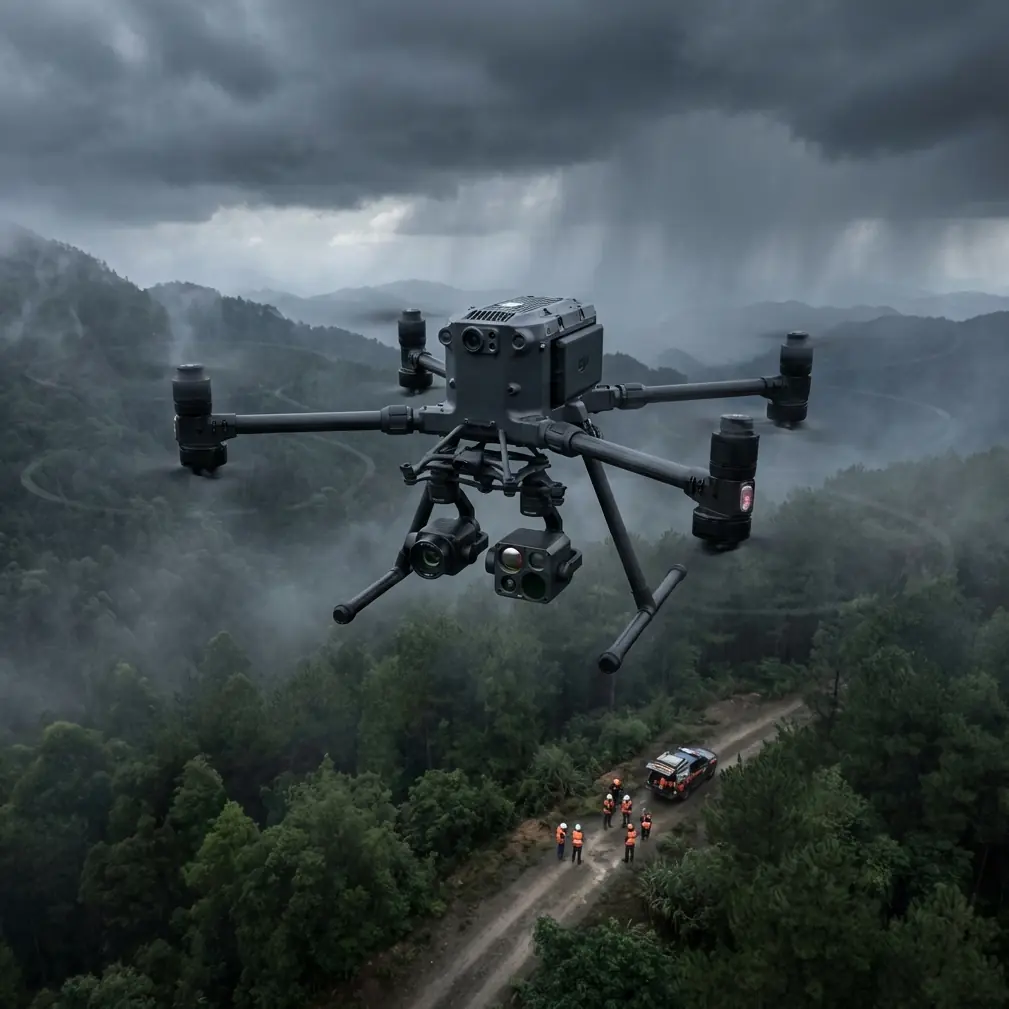
Matrice 400 for Dusty Venue Tracking: Flight Altitude, Fastener Logic, and Why Small Design Details Matter
META: Expert analysis of Matrice 400 for tracking venues in dusty conditions, with practical altitude strategy, payload stability insight, fastening reliability, and operational planning considerations.
Dust changes everything.
Not in a dramatic, marketing-brochure sense. In actual field work. At venues with exposed soil, temporary access roads, heavy foot traffic, staging vehicles, and dry wind patterns, dust becomes the quiet factor that degrades image clarity, complicates thermal interpretation, and punishes any weak point in the aircraft-payload system. If you are planning to use the Matrice 400 around dusty venues for mapping, crowd-flow infrastructure assessment, perimeter progress monitoring, or event-site logistics visibility, the question is not just whether the aircraft can fly there. The real question is how to set it up so the data stays usable and the operation stays repeatable.
That is where a more engineering-led view helps.
Most discussions around high-end UAV platforms stay at the feature level: transmission range, thermal capability, battery endurance, encryption, AI functions. Those matter. But dusty venue tracking is one of those scenarios where second-order details decide whether the sortie produces clean deliverables or just expensive ambiguity. The references behind this article come from aircraft design material on fastening standards and weight estimation methods. At first glance, they seem far removed from a Matrice 400 mission. They are not. They point straight to the practical issues that matter in the field: how components stay secure under vibration and shear loads, how equipment weight compounds through the airframe, and why altitude selection should be driven by dust behavior as much as camera resolution.
The core problem at dusty venues
A dusty venue is usually dynamic in three ways at once.
First, the air close to the ground is unstable. Ground vehicles, temporary generators, forklifts, service carts, and human movement kick particulate matter into suspension. Second, visual contrast drops unevenly. You may have a clear line over one section of the site and a brown haze over another. Third, the mission itself often involves mixed objectives: overview video for operations, thermal signature checks for equipment hotspots or occupancy patterns, and photogrammetry for layout updates or terrain change.
Those mission types do not all want the same altitude.
Flying too low gives you stronger subject detail, but it also puts the camera in the dirtiest part of the air mass. Flying too high reduces dust interference but can weaken thermal discrimination on smaller targets and can lower ground sampling detail for mapping unless your optics and overlap settings are planned carefully.
For the Matrice 400, the best starting point for dusty venue tracking is not “as low as possible for detail.” It is usually a moderate altitude window that sits above the active dust plume layer while preserving enough pixel density for your task. In many dusty venue scenarios, that means beginning test passes around the point where rotor wash is no longer interacting with loose surface dust and where vehicle-thrown particulates thin out enough for stable imaging. The exact number depends on terrain, wind, lens choice, and traffic intensity, but the principle is consistent: climb out of the dirtiest air before you chase finer detail.
That is the operational significance of altitude here. It is not just about legal ceiling or field of view. It is about leaving the contamination zone.
My practical altitude rule for this scenario
If I were building a venue-tracking workflow around the Matrice 400, I would break altitude into three bands:
- Initial reconnaissance band: high enough to get above the dust layer and read the whole site cleanly
- Task band: lowered only as far as needed for thermal or inspection-specific detail
- Mapping band: flown at a stable, repeatable height that balances GCP visibility, overlap reliability, and dust avoidance
For most dusty venues, the first pass should be conservative. Go higher than your instinct says. Let the aircraft establish a clean visual baseline, then descend selectively only for sections that truly require more detail. That sequence is especially useful when using thermal signature analysis, because airborne dust and radiant ground clutter can mislead interpretation if you start too low. Thermal works best when the scene is stable enough to separate real heat behavior from atmospheric interference and reflective noise.
Photogrammetry is just as sensitive, though in a different way. Dust can flatten texture and create inconsistencies between passes, especially on uniform surfaces like compacted dirt lots or temporary gravel paths. If your goal is terrain modeling or site-progress mapping, you want overlap and image consistency more than dramatic closeness. This is where careful GCP placement and disciplined altitude matter more than trying to squeeze out one extra layer of detail by dropping lower into haze.
Why airframe design logic matters more than people think
Here is where the reference material becomes useful.
One source discusses aircraft fasteners and notes that countersunk bolts are commonly used for fastening thin aircraft skin, with bolt diameters not exceeding 10 mm in that context. It also explains that internal hex head bolts are used where space is limited and ordinary wrench access is difficult. That may sound like old-school manned-aircraft design trivia, but the operational lesson is highly relevant to UAV payload work: constrained spaces, thin structural interfaces, and vibration-loaded joints demand the right fastening strategy.
On a professional drone like the Matrice 400, payload brackets, gimbal interfaces, sensor housings, and accessory mount points all live in a world of repeated vibration cycles, transport shocks, and environmental contamination. Dusty venues intensify that stress because fine particulates work their way into mechanical interfaces and can accelerate wear or loosen marginally secured assemblies over time. The fact that aerospace fastener guidance distinguishes between load types, access constraints, and structural thickness is not academic. It reflects the reality that “a bolt is a bolt” is bad thinking.
The same reference also states that for shear-loaded bolts, bolt length selection must account for the thread position within the clamped stack. Operationally, that matters because threads sitting in the wrong load zone can reduce joint integrity. Translate that into drone field practice and the takeaway is simple: any custom-mounted sensor, third-party bracket, or modified accessory plate on a Matrice 400 should be checked not just for tightness, but for proper hardware geometry. In a dusty venue mission, where repeated takeoffs, transport between staging points, and constant vibration are common, a poorly selected fastener can show up as image micro-jitter, alignment drift, or intermittent payload instability long before it becomes an obvious failure.
That is not theoretical. It is exactly the kind of problem that ruins a photogrammetry set quietly.
A small percentage can become a big field problem
Another reference detail is even more revealing. Several specified bolt standards are cited as having destructive tensile values reduced by 10% compared with table data. There is also a note that certain 30CrMnSiA bolts used in especially critical single-joint connections should have allowable shear selection reduced by 6%.
These are design margins, not drone setup instructions. But they point to something venue operators should respect: real-world fastening performance is not a static catalog number. Conditions, configuration, and application criticality can all justify derating.
For Matrice 400 operations, especially in dusty sites where mission success depends on stable sensor alignment and repeatability, that suggests a wise habit: treat all field-mounted interfaces with conservative assumptions. If a payload plate, auxiliary illumination bracket, RTK accessory mount, or antenna assembly is “probably fine,” that is not the same as being suitable for repeated dusty operations. Small degradations in mounting confidence can amplify through flight vibration into bad thermal registration, blurred long-zoom imagery, or inaccurate model reconstruction.
This is also why pre-flight inspection on a dusty venue should include more than motors, props, and battery status. It should include tactile verification of payload mounting points, visual inspection for abrasive dust accumulation around fasteners, and a schedule for periodic re-torque based on manufacturer guidance. Dust does not have to break a component to affect mission quality. It only needs to create enough movement to compromise the data.
Weight planning is not just about endurance
The second document deals with aircraft weight estimation and includes formulas for onboard systems. One line estimates internal equipment using crew-based factors such as 93 per flight crew member and 68 per passenger-equivalent term in one formula. Another uses a 453 multiplier tied to personnel counts in a separate equation. Those formulas come from manned-aircraft methods, so they should not be copied into drone planning directly. But they underscore a principle that absolutely applies to the Matrice 400: support systems add up faster than operators expect.
In dusty venue work, crews often think in terms of the drone plus camera. Actual field configuration is broader. You may be carrying thermal plus visual payload capability, RTK equipment for mapping precision, shielding or covers for environmental protection, extra landing accessories for rough surfaces, communication hardware leveraging O3 transmission, encrypted data handling with AES-256 workflows, and battery logistics built around hot-swap operations to keep cycles continuous.
Every added system changes the mission, even if the aircraft remains within its allowable envelope.
Extra mass affects climb response, braking feel, and reserve margins. It can also influence how confidently you can hold the exact altitude band that keeps you above suspended dust while preserving the imaging geometry you need. Venue tracking often looks simple from the outside, but operationally it sits at the intersection of endurance planning, data quality, and environmental contamination control. That is why disciplined weight configuration matters. If two payloads can solve the problem, the one with lower complexity and less mounting burden may deliver the better result, not because it is more advanced, but because it keeps the whole aircraft calmer and cleaner in the air.
Transmission and security matter differently at venues
Dusty venues are often noisy RF environments too. Temporary infrastructure, mobile devices, OB vans, Wi‑Fi clusters, and construction electronics can all stack interference around the site. A robust transmission architecture such as O3 matters here not as a spec-sheet brag, but because venue tracking often requires the pilot to hold consistent positioning while the visual observer and operations staff interpret live views in real time.
Secure handling matters as well. If the venue is private, commercially sensitive, or still under construction, image streams and collected data should be managed with the same seriousness as the flight itself. AES-256 is operationally useful because some venue missions involve layout planning, infrastructure status, restricted access areas, or crowd-management staging that should not leak casually. Security in this setting is not about secrecy theater. It is about professional control of client-sensitive site information.
A better mission flow for dusty venue tracking
For the Matrice 400, I would structure the mission like this:
High clean-air pass first
Establish site-wide visibility above the active dust layer. Capture reference imagery and identify plume sources.Thermal pass only where it adds value
Use thermal signature work selectively for generators, temporary electrical distribution, HVAC units, roof sections, or occupancy-related patterns. Avoid low-level thermal passes through visibly disturbed air if the same answer can be obtained from a cleaner altitude.Photogrammetry run with disciplined overlap
Lock your altitude, avoid impulsive descent for detail, and ensure GCPs remain visible and stable. If dust is moving across the site, repeatability matters more than heroic proximity.Short-interval landing checks during long operations
Hot-swap batteries can keep the mission moving, but dusty conditions are exactly where quick post-landing checks pay off. Look for buildup at mounting interfaces, lens contamination, and any play in payload connections.Use BVLOS planning logic only where permitted and appropriate
Even if your operation remains within visual line-of-sight, planning with BVLOS discipline improves route structure, communication checks, contingency spacing, and handoff clarity.
If you need a field-ready setup discussion for your venue environment, a quick message through our UAV planning line is often the easiest way to compare payload and altitude strategies before deployment.
The main altitude insight, stated plainly
For dusty venue tracking with the Matrice 400, the optimal flight altitude is usually the lowest altitude that keeps you out of the active dust layer, not the lowest altitude that gives maximum apparent detail.
That distinction saves missions.
It improves visual clarity, stabilizes thermal interpretation, reduces rotor interaction with loose surface particles, and supports more consistent photogrammetry. Once you get above the contamination zone, you can let optics, overlap discipline, and targeted sub-missions recover the detail you need.
What separates a good result from a usable result
The Matrice 400 is the kind of platform people often evaluate by capability ceiling. For dusty venues, that is the wrong frame. The smarter frame is capability discipline.
Can the aircraft carry advanced sensors? Yes. Can it support secure workflows, stable transmission, and long operational windows with hot-swap batteries? Yes. But the quality of the result depends on less glamorous decisions: conservative altitude selection, proper GCP strategy, realistic interpretation of thermal signature data, and serious attention to mounting integrity.
That last point is where the aircraft design references quietly become relevant. A world of aviation engineering has spent decades proving that fastener choice, load path awareness, and weight accounting are not side issues. They are the skeleton of reliability. When you apply that mindset to a Matrice 400 in a dusty venue, you stop treating the mission like “fly and film” and start treating it like professional aerial data acquisition under contamination stress.
That is the shift that produces cleaner outputs and fewer surprises.
Ready for your own Matrice 400? Contact our team for expert consultation.