
Matrice 400 in Extreme Temperatures: A Field Report
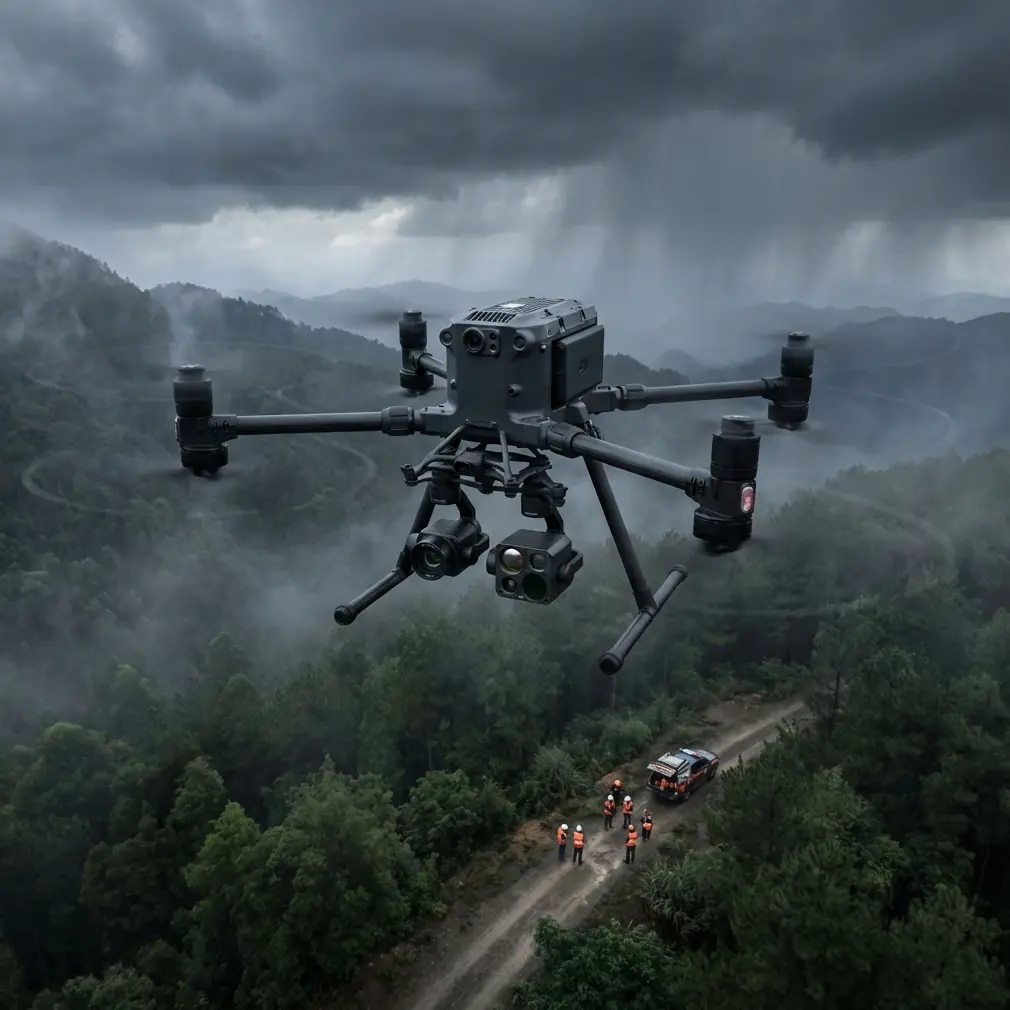
Matrice 400 in Extreme Temperatures: A Field Report on Tracking, Safety Margins, and the Pre-Flight Checks That Matter
META: Expert field report on using the Matrice 400 for venue tracking in extreme temperatures, with practical guidance on thermal workflows, pre-flight safety checks, navigation reliability, and operational planning.
I’ve seen plenty of drone teams obsess over payload choice, route planning, and battery timing, then rush through the small physical checks that quietly determine whether the day stays routine. With a platform like the Matrice 400, especially when the mission is tracking activity across large venues in extreme temperatures, that shortcut is a mistake.
Not because the aircraft lacks capability. Quite the opposite. A serious enterprise platform can handle punishing workloads, long transmission distances, thermal operations, mapping tasks, and complex coordination. The issue is that harsh environments expose weak habits before they expose weak hardware.
For venue tracking, that matters more than many operators admit. Stadium perimeters, industrial campuses, outdoor event grounds, transport depots, ski facilities, solar sites, and remote mixed-use properties all create the same operational tension: you need dependable overwatch, clean positional awareness, and stable data capture in conditions that punish both aircraft and crew. Heat bakes surfaces until thermal contrast shifts by the minute. Cold changes battery behavior, stiffens seals, and can turn a little condensation into a sensor problem. Dust, grit, frost, and moisture don’t need much of an opening.
That’s why my starting point for the Matrice 400 isn’t flight time. It isn’t top speed either. It’s surface integrity and systems discipline.
The small pre-flight cleaning step most teams undervalue
Before launch, I want the aircraft cleaned with intent, not just wiped down for appearance. The practical target is simple: any area that could contact the ground in an abnormal landing, skid, or slide should be free from built-up grime, adhesive residue, ice, hardened mud, or anything that can create drag or catch.
That sounds basic until you connect it to aircraft design logic. One of the reference engineering principles from classical rotorcraft crashworthiness is that zones likely to scrape or plow into the ground should be shaped as large, smooth surfaces to encourage sliding rather than digging in. The same source also stresses minimizing inward buckling at the nose or engine-bay area so those sliding surfaces stay intact during impact. Those are not abstract textbook ideals. Operationally, they point to something field crews can act on: if a drone’s lower structure, landing interface, or forward underside is contaminated, roughened, or carrying debris, you are increasing the chance that a hard touchdown behaves badly.
For a Matrice 400 crew tracking venues in extreme temperatures, this translates into a concrete pre-flight ritual:
- remove frozen slush, compacted dirt, and sticky residue from landing gear contact zones
- inspect belly surfaces and forward lower contours for chips, protrusions, or cracked covers
- clean payload windows and thermal optics separately from structural surfaces
- make sure drain paths, seals, and latch points are not obstructed by dust or ice
Why does this matter? Because a hard landing is not always a dramatic event. In crosswinds, on rough temporary staging areas, or after a rapid return-to-home in thermal haze, the difference between a manageable skid and a snagging impact can come down to surface condition. Smooth contact geometry helps energy dissipate in motion rather than convert instantly into tumbling or structural intrusion.
That same crashworthiness reference gives another useful figure: designers are expected to analyze helicopter structures for vertical impact conditions around 12.8 m/s onto a hard level surface, with limits on cabin deformation, and to consider impact attitudes including pitch from +15° to -5° and roll of ±10°. The Matrice 400 is not a helicopter, and venue operators are not crash-test engineers. But the operational lesson still carries over: aircraft safety isn’t just about normal flight envelopes. It’s about what happens when attitude, descent rate, and surface conditions stop being ideal. Extreme temperature operations narrow those margins fast.
Tracking venues is really a navigation problem first
People often frame venue tracking as a camera problem. It’s usually a navigation problem wearing a camera-shaped mask.
If you’re running thermal signature sweeps over a large venue in cold dawn conditions, the sensor only helps if the aircraft knows precisely where it is, holds that position reliably, and keeps mission logic coherent when the environment becomes confusing. Heat shimmer, low-angle glare, repetitive architecture, reflective roofing, and snow-covered open areas all make visual interpretation harder. In those conditions, your workflow leans heavily on the navigation stack and on how well the aircraft integrates multiple positioning sources.
That is where another reference detail becomes surprisingly relevant. The source material on aircraft systems integration stresses that positioning architecture should not be treated as a single black box. It explicitly distinguishes independent navigation and sensing elements such as inertial navigation systems, Doppler radar, weather radar, radio altimeters, and terrain warning functions, while also separately identifying related positioning systems like DME, ATC transceivers, radio compass, VOR, Omega, and GPS. More importantly, it says designers must define the basic composition, working method, installation position, and technical requirements of those systems.
For Matrice 400 operators, the value is conceptual and immediate. Redundancy in positioning is not marketing fluff. It is the backbone of dependable venue tracking when one source becomes less trustworthy. In practical field terms:
- GNSS gives you broad geospatial confidence
- inertial behavior stabilizes continuity when signal quality fluctuates
- altitude awareness matters around seating bowls, roof edges, masts, and temporary structures
- transmission integrity matters because tracking decisions are only as good as the live picture and aircraft telemetry reaching the pilot
This is where O3 transmission and secure link management become operational tools rather than brochure terms. On a sprawling venue, especially one with reinforced concrete, steel, LED infrastructure, and heavy RF congestion, maintaining a stable command-and-video path is central to safe tracking. If the aircraft supports AES-256 link security, that matters too, not just for privacy, but for chain-of-custody confidence when the mission involves sensitive commercial sites, VIP movements, or infrastructure monitoring. Clean transmission and secure telemetry help the crew trust what they are seeing and recording.
Thermal tracking in heat and cold: what changes in the field
Extreme temperatures don’t just stress components. They distort interpretation.
In cold conditions, thermal signature work often looks easier than it really is. Human movement, vehicles, generator sheds, and access points may stand out crisply at first light, but once the sun starts striking metal railings, roofing membranes, parked equipment, and asphalt edges, your thermal scene becomes layered with false attention points. In high heat, the inverse happens: ambient loading can flatten contrast, making meaningful targets less obvious and forcing tighter control over angle, timing, and background.
On the Matrice 400, that means the operator should think in passes, not just patrols. Build the mission around comparison windows. Fly one route for perimeter tracking, another for elevated oblique verification, and a third for wider context if thermal anomalies need explanation. Don’t ask one orbit to do everything.
If the venue also needs mapping or incident reconstruction, photogrammetry can complement thermal work well, but only if you maintain discipline with GCP strategy and timing. I prefer to separate the objectives operationally. Thermal tracking is about live interpretation. Photogrammetry is about geometric reliability. Trying to compromise both in one rushed sortie usually weakens each. The Matrice 400 has the kind of enterprise utility that invites stacking tasks, but stacking tasks is not the same as integrating workflows intelligently.
Hot-swap batteries are more than a convenience in bad weather
Battery handling in extreme temperatures is one of the clearest dividing lines between crews that operate professionally and crews that improvise.
Hot-swap batteries are often discussed as a productivity feature. In venue tracking, they are really a continuity feature. If the Matrice 400 can remain mission-ready with minimal downtime between battery exchanges, the crew can preserve surveillance rhythm, maintain route cadence, and avoid blind intervals during peak activity periods. That becomes even more important in cold weather, where battery temperature management before flight can heavily influence performance consistency.
The discipline here is straightforward:
- keep spare batteries staged within their recommended thermal range
- avoid leaving packs exposed on vehicle tailgates, frozen ground, or direct solar baking surfaces
- verify latch engagement and contact cleanliness during each swap
- inspect for condensation when moving equipment between heated interiors and cold exteriors
Again, this ties back to the larger systems-thinking in the reference material. Good aircraft design doesn’t isolate major systems from installation, location, maintenance, and display of operating condition. In the field, the same principle applies to drone power. A battery is not just energy storage. It is part of the total reliability chain that includes monitoring, mounting, environmental exposure, and turnaround procedure.
Why surface condition and payload cleanliness affect tracking quality
I mentioned pre-flight cleaning for safety, but on the Matrice 400 it has a second effect: tracking quality.
Dust on optical glass is obvious. What teams miss is how grime elsewhere degrades the mission more subtly. Dirt around moving interfaces can alter deployment behavior. Residue near vents changes thermal balance. Salt spray and fine dust buildup can complicate cooling in high-heat operations. Frost around seams can become meltwater exactly when the aircraft transitions from cold ambient air to internal warming.
For thermal payloads, even a small contamination issue can soften edge definition or create interpretive noise during critical moments. If your assignment is following movement across a venue boundary, identifying occupancy in service lanes, or checking patterns near infrastructure choke points, soft or inconsistent thermal imagery wastes time. The crew starts second-guessing what should have been clear.
My rule is simple: the aircraft gets one cleaning protocol, the payload gets another, and both are logged mentally before takeoff. If your team needs a practical pre-deployment checklist for harsh weather setup, I usually suggest sending the ops lead a direct field brief here: message our flight prep desk.
BVLOS thinking starts before the aircraft leaves the ground
Even when a mission remains within the legal and procedural constraints of the day’s authorization, the best venue tracking crews plan with BVLOS discipline. By that I mean they structure operations as if link resilience, route predictability, telemetry clarity, and contingency handling must stand on their own without casual visual correction.
That mindset improves everything.
It sharpens geofence planning.
It tightens lost-link behavior.
It forces cleaner launch site selection.
It encourages deliberate altitude bands around structures and crowd-free commercial zones.
And it makes transmission health something the crew watches continuously rather than only when it degrades.
For the Matrice 400, this is where platform maturity should pay off. A serious enterprise aircraft should let operators integrate tracking, thermal observation, mapping support, and site awareness without turning the pilot’s task into guesswork. But the aircraft can only express that capability if the mission has been built around system reliability from the start.
The field reality: venue tracking is a choreography of margins
What separates a strong Matrice 400 operation from an average one is not usually a dramatic technical trick. It’s the crew’s respect for margins.
Margins in landing behavior.
Margins in link stability.
Margins in battery temperature.
Margins in positional certainty.
Margins in image interpretation.
The reference material on rotorcraft crash design may seem distant from a modern enterprise UAV mission, yet it contains one of the clearest operational truths in aviation: shape, structure, and energy management decide what happens when conditions stop cooperating. Large smooth contact areas that encourage sliding, and structural arrangements that reduce harmful inward deformation, are fundamentally about preserving outcomes when control is imperfect. That same philosophy belongs in every Matrice 400 venue-tracking plan.
Likewise, the aircraft systems integration reference reminds us that positioning and mission systems are not one feature. They are a coordinated architecture with defined composition, working logic, installation constraints, and technical standards. For drone teams, that should translate into a more rigorous view of GNSS, inertial consistency, altitude awareness, transmission reliability, and onboard monitoring.
So if you are preparing the Matrice 400 for extreme-temperature venue tracking, start before the batteries go in. Clean the surfaces that matter. Verify the interfaces that hold the aircraft together. Treat navigation as a layered system. Use thermal and photogrammetry for their distinct strengths. Build around continuity, not just endurance.
That is how you get dependable results when the venue is large, the weather is unfriendly, and the mission cannot afford sloppy assumptions.
Ready for your own Matrice 400? Contact our team for expert consultation.