
Matrice 400 Field Report: Tracking Remote Vineyards Without
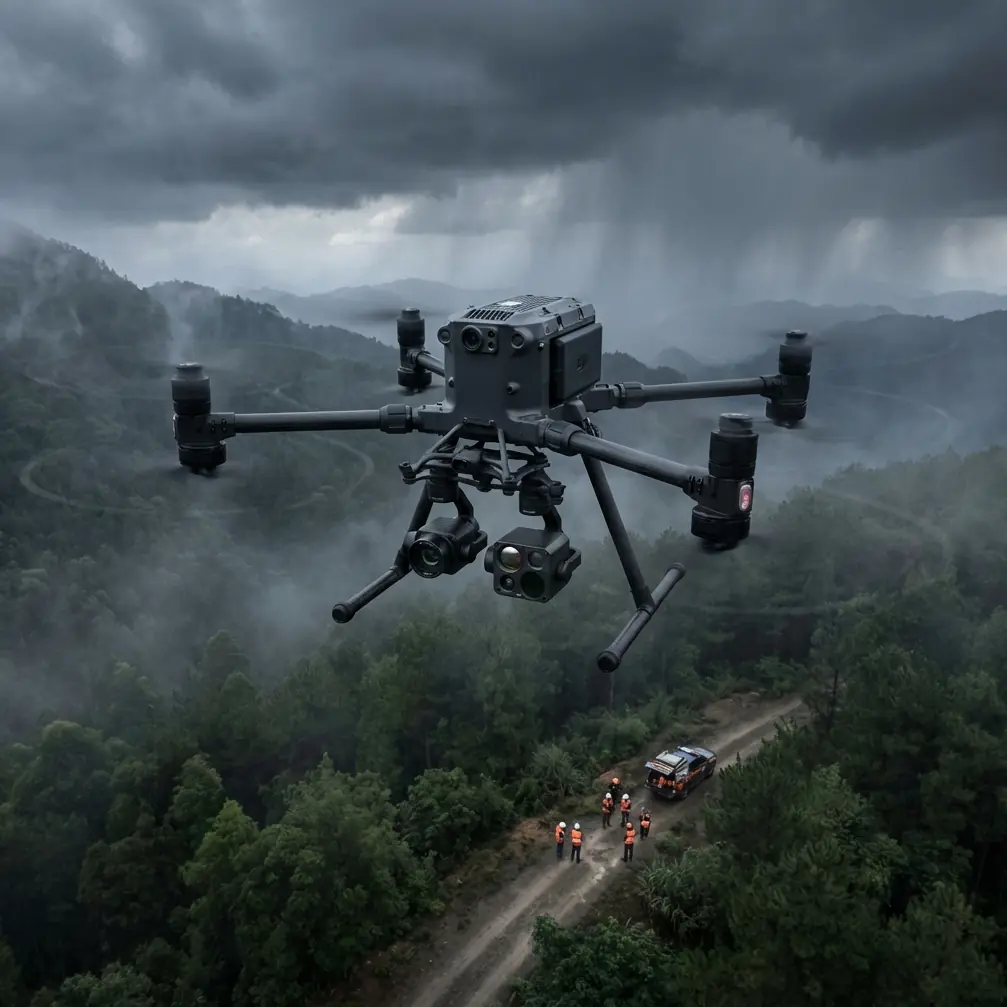
Matrice 400 Field Report: Tracking Remote Vineyards Without Losing the Plot
META: Expert field report on using the DJI Matrice 400 for remote vineyard tracking, covering thermal workflows, photogrammetry, GCP strategy, O3 transmission, AES-256 security, hot-swap batteries, and BVLOS planning.
Remote vineyards expose every weakness in an aerial workflow. Terrain blocks signal. Rows bend around ridgelines. Heat pools in low sections at sunrise and burns off unevenly by mid-morning. If you are trying to monitor vine stress, irrigation drift, pest pressure, fence-line breaches, or animal intrusion, the aircraft matters less as a spec sheet and more as a field instrument that can stay stable, keep transmitting, and produce data you can actually trust when the access road disappears behind you.
That is where the Matrice 400 fits the conversation.
This is not a generic praise piece for a flagship platform. Think of it as a field report built around a practical question: how does a Matrice 400-style workflow hold up when the job is tracking vineyard conditions in remote blocks where battery changes, data integrity, and line-of-sight limitations all shape what can be accomplished in a single mission window?
I have worked enough ag and land-management flights to know that remote vineyard monitoring is rarely one job. It is three jobs layered together. First, you need visual context for rows, canopies, access tracks, and perimeter condition. Second, you need a thermal signature that helps separate a thirsty zone from a mere shadow line. Third, you need consistent geospatial quality so that the map from today still lines up with the map from last week after the tractors, workers, and weather have all changed the surface cues.
The Matrice 400 conversation gets interesting because it supports that layered reality.
Why the platform matters in remote vineyard operations
A remote vineyard is unforgiving on logistics. When the launch point is far from the block you actually care about, endurance and continuity stop being abstract benefits. They determine whether you can finish a photogrammetry run, repeat a thermal pass at the correct angle, and still reserve time for targeted inspection over a suspect irrigation corridor or damaged row.
Hot-swap batteries are one of those details people tend to treat as a convenience feature until they are working a slope in patchy morning wind. Operationally, hot-swap capability changes the rhythm of the day. Instead of shutting the entire mission down and rebuilding momentum after every power cycle, the crew can keep the aircraft in a more continuous working pattern. For vineyards spread across remote parcels, that matters because the best thermal window is short. If you lose it during a full reset, the data changes. Leaf temperature contrast tightens. Moisture-related anomalies become less obvious. Small delays create interpretation problems later in the office.
The second detail that deserves more attention is O3 transmission. In open farmland close to the pilot, strong transmission is nice to have. In broken vineyard terrain with contour changes, tree breaks, service roads, and structures that interrupt signal geometry, it becomes central to mission confidence. A robust link is not only about seeing the live feed. It shapes whether the operator can hold a consistent inspection pace without repeated pauses, repositioning, or conservative route trimming. That translates directly into coverage quality. If you are mapping a remote block and must repeatedly compensate for weak transmission, you often sacrifice overlap discipline or skip edge sections that later become blind spots in the model.
Security also matters more than many agricultural teams admit publicly. Vineyards are not just crops. They are IP, yield forecasts, water management decisions, labor patterns, infrastructure layouts, and in some regions part of larger estate operations with sensitive land data. AES-256 encryption is therefore not a technical footnote. It is an operational control. When flights are collecting imagery and telemetry over remote properties, especially those shared between consultants, growers, and asset managers, encrypted transmission helps protect survey integrity and keeps sensitive geospatial information from becoming casually exposed.
Building a vineyard workflow around thermal and map-grade outputs
The real value of the Matrice 400 in a vineyard setting is unlocked through workflow design, not by simply sending it up with a camera and hoping the images reveal something useful. In remote terrain, the order of operations matters.
I prefer to split the mission day into two distinct phases.
The first phase is thermal reconnaissance. This is where the objective is not to create a pretty image but to identify temperature behavior that deserves a closer look. A thermal signature across vineyard rows can indicate uneven irrigation, blocked emitters, root-zone stress, pooling moisture, or in some cases early canopy decline. The trick is to interpret thermal in context. A hot patch on a slope shoulder may reflect soil exposure or wind desiccation rather than a failed irrigation line. A cooler strip may be healthy vigor, or it may simply be cast shadow from terrain at the time of capture.
That is why the second phase matters: photogrammetry.
Once thermal points the team toward anomalies, a structured photogrammetry mission gives you the repeatable spatial framework needed to compare blocks over time. Good orthomosaics and surface models let managers isolate whether a suspected problem follows row alignment, topography, drainage pathways, road compaction, or equipment movement. The Matrice 400 is particularly useful in this context because remote vineyard operations often require multiple mission types in one deployment cycle. You may start broad, then tighten into a higher-resolution grid, then shift to a manual inspection over a culvert, pump site, or fence line without swapping the whole operational mindset.
Ground control points, or GCPs, still deserve discipline here. Some crews act as if modern RTK-capable workflows make GCP strategy optional. In difficult vineyard terrain, that is a mistake. A well-placed GCP network helps anchor repeat surveys, especially when flights are performed weeks apart under different light conditions and with varying canopy density. If the objective is to track subtle change rather than create a one-off map, control quality matters. You do not want to debate whether a shift in an output is a plant-health issue or a georeferencing issue.
For remote vineyards, I recommend treating GCP placement as part of access planning, not an afterthought. Put them where the team can recover them safely and where they remain visible above the visual noise of row structure. A handful of correctly positioned points often does more for usable vineyard analytics than a larger number scattered without regard to terrain logic.
A wildlife moment that changed the mission plan
One of the more revealing flights I have seen in this kind of environment involved a remote vineyard edge bordered by scrub and a shallow creek line. The original task was simple enough: inspect a block showing uneven vigor and confirm whether thermal variation matched a suspected irrigation fault. Mid-pass, the thermal view picked up movement near the lower perimeter. At first glance it read like a warm ground cluster, too irregular to be machinery and too mobile to ignore.
It turned out to be a small group of feral deer moving through the edge corridor.
That encounter changed two things immediately. First, it reminded the crew that thermal interpretation in agricultural settings is never limited to crop physiology. Wildlife generates signatures that can confuse inexperienced analysts, especially in dawn operations when the temperature gap between animal bodies and surrounding vegetation is pronounced. Second, it showed the practical value of stable sensor awareness and reliable live transmission. Because the crew could maintain situational awareness, they adjusted the route without pushing the aircraft into a rushed maneuver over the animals or compromising the mapping line more than necessary.
This matters operationally for vineyards because wildlife pressure is not peripheral. It affects fence integrity, row damage, and crop loss. A remote vineyard tracking mission that can safely identify animal movement while staying on task delivers more than imagery. It gives the manager a fuller picture of what is shaping block performance.
BVLOS planning is not a checkbox
Any serious discussion of the Matrice 400 in remote vineyard monitoring eventually touches BVLOS operations. The acronym gets thrown around too casually. Flying beyond visual line of sight is not simply a longer version of a normal mission. It changes the planning burden, the risk model, and the value of every onboard and link-level reliability feature.
For vineyards distributed across difficult terrain, BVLOS can be the difference between practical coverage and repeated repositioning that burns time, batteries, and staff attention. But it only works when the mission architecture is built around communications confidence, route contingency, terrain understanding, and regulatory discipline.
Here again, O3 transmission and secure communications are not decorative specs. They support the kind of confidence envelope that remote operators need when the aircraft is working farther from the launch team than would be comfortable in a basic visual operation. The better your command and situational feedback, the more precisely you can execute preplanned routes and respond to unexpected variables like wind funnelling through a valley or animal activity near the block edge.
If your operation is moving toward more advanced remote coverage models, this is the stage where outside review helps. For teams sorting out communications planning, payload strategy, or operator workflow for large vineyard estates, I usually suggest getting a second set of eyes on the mission design through a quick field planning consult like this: message a UAV operations specialist.
What separates useful data from expensive noise
The Matrice 400 can help produce excellent agricultural intelligence, but only if the operator resists the temptation to collect everything at once. Remote vineyards produce a lot of tempting targets: stressed rows, access erosion, wildlife trails, drainage cuts, netting damage, trellis issues, pump infrastructure, neighboring vegetation, and heat anomalies near hard surfaces. The aircraft will let you look at all of it. That does not mean you should try to fold every objective into one undisciplined sortie.
A stronger approach is to define the decision you need the data to support.
If the question is irrigation uniformity, thermal timing and repeatability matter most. If the question is canopy volume trend, photogrammetry consistency and GCP quality move to the front. If the question is perimeter intrusion or animal movement, route planning and sensor interpretation discipline become central. The Matrice 400 earns its place when the team uses its endurance, transmission stability, and secure data handling to support a defined analytical sequence rather than a sightseeing exercise over the property.
There is also a personnel angle here. Remote vineyard tracking is often carried out by lean teams. One pilot may also be managing mission review, field notes, and stakeholder communication. A platform that reduces stop-start disruption through hot-swap batteries and maintains a dependable transmission link does not just improve flight smoothness. It lowers cognitive load. That can be the hidden difference between a clean dataset and a fragmented one, especially during long field days.
Practical best practices for remote vineyard missions
If I were setting up a Matrice 400 deployment for a vineyard client in isolated terrain tomorrow morning, the checklist would be brutally practical.
Start thermal early, before the vineyard equalizes thermally and subtle irrigation differences become harder to read. Follow that with a photogrammetry block while the light is still predictable enough for consistent image matching. Place GCPs with slope, visibility, and recovery time in mind. Do not assume your map accuracy problem will solve itself in processing.
Use the live link strategically. O3 transmission gives the operator more flexibility, but flexibility should serve planning, not encourage sloppy route changes. Keep manual diversions short and documented so the data remains comparable later. If you are handling sensitive property information or operational footage, keep encryption protocols active and workflow permissions tight. AES-256 only helps if the team treats the data chain seriously.
And if wildlife appears, do not force the mission. The deer example I mentioned is not unusual. In remote vineyard environments you may also encounter birds of prey, livestock movement near boundaries, or smaller mammals crossing low rows at dawn. Thermal can reveal them before the standard visual feed does. That is a safety and interpretation advantage if the crew is trained to respond calmly.
Final assessment
The Matrice 400 makes sense for remote vineyard tracking not because it promises miracle outcomes, but because its practical capabilities line up with real agricultural constraints. Hot-swap batteries support continuity during narrow thermal windows. O3 transmission improves confidence in difficult terrain where signal stability affects coverage quality. AES-256 addresses a data-security reality that serious operators should not ignore. And when the mission combines thermal signature analysis, photogrammetry, disciplined GCP placement, and a realistic path toward BVLOS operations, the result is not just more flight time. It is better operational judgment.
That is the difference vineyards actually need.
Remote blocks do not reward hype. They reward aircraft systems and field methods that keep producing reliable information when the ground is steep, the signal path is messy, and the nearest easy landing spot is not where you want it to be. In that environment, the Matrice 400 is less a prestige platform than a working tool for teams that need to see the vineyard clearly, map it accurately, and react intelligently when the land throws something unexpected into frame.
Ready for your own Matrice 400? Contact our team for expert consultation.