
Matrice 400 in Coastal Vineyards: A Field Report on What
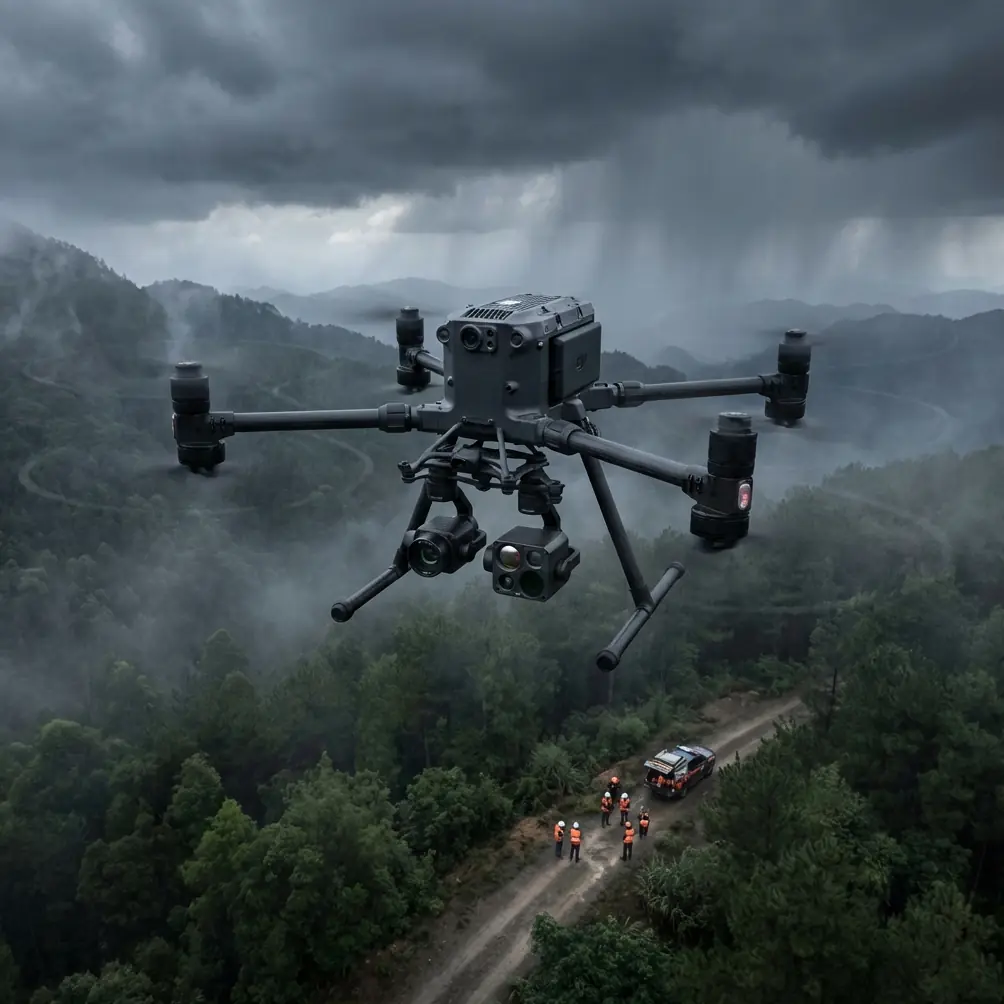
Matrice 400 in Coastal Vineyards: A Field Report on What Actually Matters
META: Expert field report on using the DJI Matrice 400 for coastal vineyard monitoring, thermal surveys, photogrammetry, BVLOS planning, battery strategy, and secure data workflows.
Coastal vineyards punish weak aircraft.
That sounds dramatic until you spend a week flying above rows cut into windy slopes, with salt in the air, patchy GNSS reception near terrain breaks, and a narrow weather window that can close before lunch. In that environment, the value of a drone is not defined by the spec sheet headline alone. It comes down to whether the platform can hold a stable line over vines, carry the right sensor stack, maintain a dependable link, and keep the crew moving when timing matters.
That is where the Matrice 400 becomes interesting.
I am not talking about it as a general-purpose flagship, or as a placeholder for “bigger equals better.” I am looking at it through a narrower lens: vineyard operators and agronomy teams working in coastal conditions, where wind, topography, and time-sensitive crop decisions shape every mission. If your objective is to track stress patterns, verify irrigation performance, map canopy development, and revisit the same blocks with repeatable data quality, the Matrice 400 stands out for reasons that are practical rather than flashy.
Why coastal vineyards expose weaknesses fast
A flat inland farm is one thing. A coastal vineyard is another.
Rows can run across uneven ground. Airflow changes as sea breezes push inland. Moisture hangs around early, then lifts. Fog can sit low in one parcel and miss the next. If you are building a monitoring program, you need more than “the drone flies.” You need a system that can:
- keep a stable route in moving air
- support repeatable imaging for photogrammetry
- switch between visible and thermal work without wasting field time
- protect collected data when multiple stakeholders are involved
- cover enough area per sortie that the operation stays economical
This is why the Matrice 400 deserves serious attention in vineyard work. It fits a category that many competing platforms try to reach but often miss in the field: high-end utility without turning every mission into a logistics exercise.
The transmission link matters more than many growers expect
Let’s start with one detail that often gets buried under payload discussions: O3 transmission.
In coastal vineyard operations, transmission reliability is not a luxury feature. It affects mission continuity, image confidence, and pilot decision-making. Terrain breaks, trellising patterns, vegetation density at field edges, and reflective moisture can all create small but consequential disruptions. A stronger transmission ecosystem gives the pilot cleaner situational awareness and reduces the number of awkward pauses, aborted lines, or conservative route cuts that shrink useful coverage.
O3 transmission is operationally significant because vineyards are rarely surveyed for the sake of flying itself. They are surveyed to feed decisions. If a viticulture team is comparing stress conditions block by block, or a consultant is verifying drainage behavior after a weather event, incomplete coverage introduces uncertainty. A robust link helps the aircraft stay productive across the mission rather than forcing the pilot to constantly compensate for signal anxiety.
Against smaller enterprise aircraft or lower-tier mapping setups, this is one of the places the Matrice 400 can separate itself. Competitors may offer decent imaging, but when wind, terrain, and distance start stacking together, the quality of the data pipeline from aircraft to operator becomes a real differentiator.
Thermal signature work is not just for dramatic heat maps
Vineyard clients often ask for thermal because they want a pretty image. That is the wrong starting point.
Thermal signature analysis becomes valuable when it is tied to an agronomic question. Are certain rows drying sooner than expected? Is an irrigation zone underperforming? Are there vine sections showing early stress before visible symptoms become obvious? In coastal sites, these questions matter even more because microclimates can shift across short distances.
The Matrice 400’s relevance here is not simply that it can participate in thermal workflows. It is that it belongs to the class of aircraft capable of carrying serious sensor payloads while maintaining the steadiness needed for useful, repeatable capture. Repeatability is everything in vineyard monitoring. One thermal pass is interesting. A sequence of thermal passes, captured under consistent planning and interpreted against field context, becomes operationally useful.
That means thermal data can move beyond “heat differences exist” and toward “this block needs inspection now” or “this irrigation line needs checking before the next cycle.”
In practice, that shortens the distance between aerial observation and field action.
Photogrammetry in vineyards is easy to get wrong
People talk about photogrammetry as if pressing “start” is enough. Vineyards expose every shortcut in that thinking.
Rows create repeating patterns. Slopes distort perspective. Light can be harsh in one section and diffused in another. If your overlap, altitude, and control strategy are not disciplined, outputs can become visually impressive but analytically weak.
This is where GCPs still matter.
Yes, modern RTK and flight automation have improved dramatically. No, that does not make Ground Control Points obsolete for vineyard mapping. In coastal estates where elevation shifts and parcel boundaries can affect planting, drainage, replant planning, or infrastructure work, GCPs remain one of the best ways to tighten confidence in final outputs.
The Matrice 400 supports a more rigorous photogrammetry workflow because it is built for professional mission consistency. That matters when you are producing orthomosaics, terrain models, or canopy volume comparisons that someone will actually use in a management meeting. A less capable platform may still produce a map. The question is whether the map is trustworthy enough to justify decisions.
For vineyards, the best use of photogrammetry is rarely just “having a map.” It is being able to compare one survey against another and defend the differences as real, not artifacts from inconsistent capture.
Battery strategy decides whether your survey day is smooth or chaotic
There is one feature that field crews appreciate immediately: hot-swap batteries.
This is not glamorous. It is one of the most useful capabilities on a serious enterprise platform.
In vineyards, battery changes often happen at awkward moments. You may be moving between blocks, trying to preserve the same lighting conditions, or racing wind that is expected to rise later in the day. A hot-swap battery system reduces downtime and keeps the workflow coherent. Instead of powering down fully and rebuilding the mission rhythm every time, crews can rotate power faster and stay focused on capture quality.
Operationally, this affects more than convenience. It helps preserve consistency across adjoining survey segments, which can improve downstream processing. It also makes it easier to schedule the day around agronomy priorities rather than around the aircraft’s interruptions.
Compared with many competing systems that are perfectly capable but more stop-start in their field routine, the Matrice 400 feels more like a working tool and less like a device that needs constant babysitting.
Security is not theoretical when vineyard data is shared
High-value vineyards are data-sensitive environments.
Owners, agronomists, irrigation consultants, managers, and outside service providers may all touch the same imagery. Block condition, production strategy, disease pressure indicators, and infrastructure layouts are not details every operator wants floating around casually. That is why AES-256 deserves more attention in this discussion.
AES-256 is not just a technical checkbox. It is part of a professional data handling posture. For vineyard groups managing sensitive operational data across teams, stronger encryption helps support secure transmission and handling practices. If your workflow includes cloud upload, stakeholder review, or data movement between contractors and estate management, security architecture matters.
This is one area where professional-grade platforms distinguish themselves from cheaper alternatives that may seem adequate until governance questions appear. A vineyard operation does not need militarized language or overblown claims. It needs confidence that its survey data is handled responsibly. AES-256 contributes to that confidence.
BVLOS is relevant, but only when the operation is mature enough
BVLOS gets mentioned too casually in drone conversations.
For vineyards, Beyond Visual Line of Sight planning can be meaningful on large estates or distributed holdings, especially where road access between parcels slows down conventional visual operations. But BVLOS is not a magic setting. It is a regulatory, procedural, and risk-managed framework. The value of the Matrice 400 here is that it belongs to the category of aircraft serious operators would consider when building compliant, scalable workflows.
In a coastal vineyard context, BVLOS relevance shows up when operators want to reduce repositioning time, maintain continuity over elongated parcels, or monitor remote blocks more efficiently. The aircraft alone does not make that possible. The operation design does.
Still, platforms that support sophisticated mission planning, stable transmission, and enterprise-grade reliability are the ones that enter the BVLOS conversation credibly. The Matrice 400 fits that profile far better than drones designed primarily for short-range visual tasks.
Where it beats many competitors in real vineyard work
A lot of competing aircraft look strong in isolated categories. One may be compact. Another may have a good camera. A third may have acceptable endurance in perfect conditions. Coastal vineyard work is a harsher test because it forces all those qualities to work together.
The Matrice 400 excels when you judge the whole field system rather than one spec at a time.
It combines:
- enterprise-class transmission through O3
- payload flexibility for thermal and mapping missions
- workflow efficiency through hot-swap batteries
- secure operations supported by AES-256
- the mission stability expected in advanced photogrammetry programs using GCP-backed validation
That package matters because vineyards rarely need a drone for only one thing. The same estate may want canopy vigor monitoring this week, drainage analysis after rain, thermal inspection during a stress window, and updated terrain outputs for planning next month. Switching between these jobs is easier when the aircraft is not operating at the edge of its comfort zone.
That is the Matrice 400 advantage. It feels purpose-built for demanding civilian field operations rather than adapted to them.
A practical workflow for coastal vineyard teams
If I were setting up a Matrice 400 program for a coastal vineyard, I would build it around repeatability.
First, establish standard mission profiles by block type. Flat sections, sloped parcels, and fragmented rows should not all be flown the same way. Second, use GCPs selectively but consistently in zones where high-confidence outputs matter most. Third, schedule thermal missions based on agronomic relevance, not on when the aircraft happens to be available. Fourth, treat battery rotation and crew movement as part of the data strategy, not just field convenience.
And fifth, secure the information chain from day one.
A vineyard operation can spend months collecting useful imagery, then undermine the value of that program with inconsistent file handling and unclear stakeholder access. Enterprise features such as AES-256 help, but they work best when paired with disciplined operating procedures.
The result is not just a nicer drone workflow. It is a better management system.
Final field take
The Matrice 400 makes the most sense in vineyards where drone data is expected to support real decisions, not occasional curiosity.
If the estate needs dependable thermal signature work, serious photogrammetry, cleaner long-range transmission through O3, and the time savings of hot-swap batteries, this platform earns its place quickly. Add data security considerations and future-facing BVLOS planning, and its position becomes even stronger.
Smaller drones can absolutely do useful vineyard work. Some do it very well. But in coastal operations where conditions are less forgiving and outputs need to stand up to scrutiny, the Matrice 400 is in a different class. Not because it is bigger. Because it removes friction in the places that professionals actually feel.
If you are planning a vineyard monitoring setup and want to discuss payload fit, survey design, or coastal mission planning, you can reach out directly here: message James Mitchell on WhatsApp
Ready for your own Matrice 400? Contact our team for expert consultation.