
Matrice 400 in Vineyard Winds: A Practical Field View
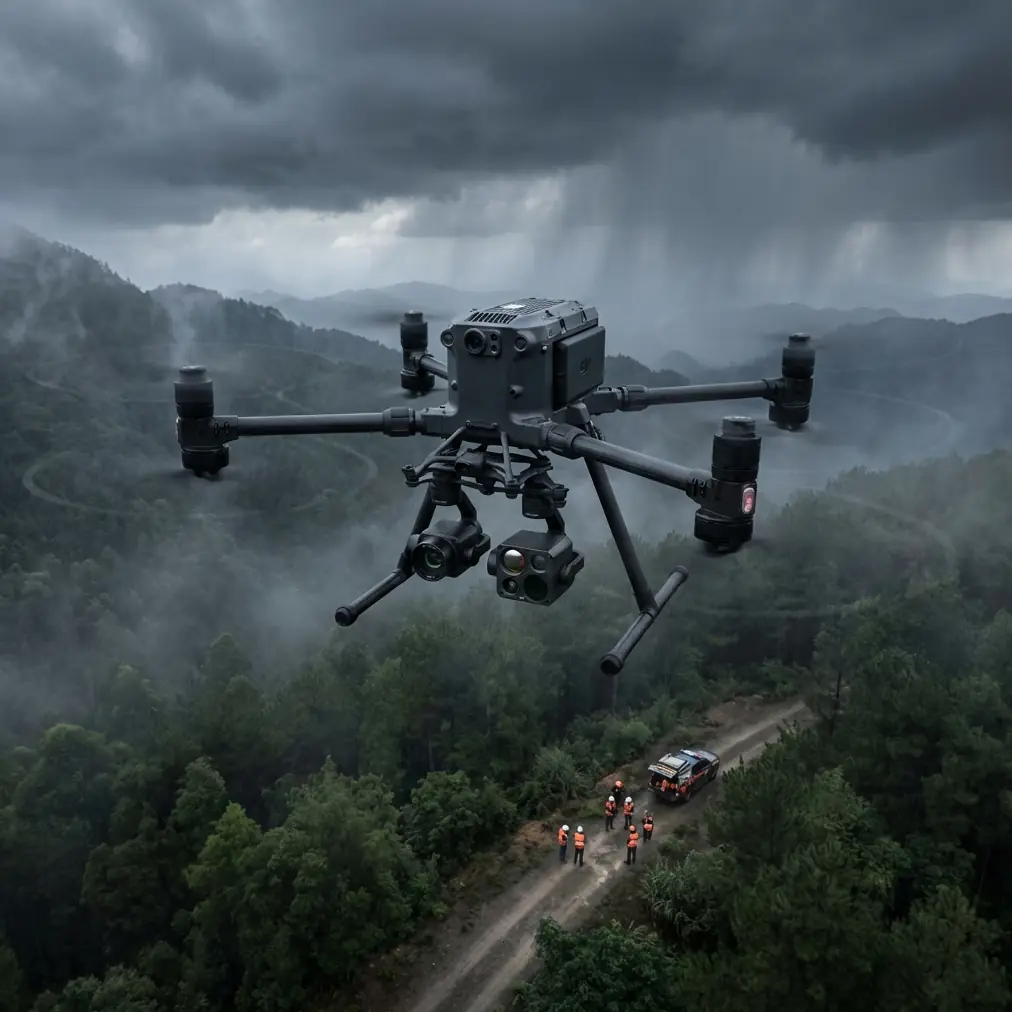
Matrice 400 in Vineyard Winds: A Practical Field View on Tracking, Mapping, and Staying Stable
META: An expert look at how the Matrice 400 fits windy vineyard operations, from stable flight and sensor confidence to thermal signature work, photogrammetry, hot-swap batteries, and secure data handling.
By Dr. Lisa Wang, Specialist
Wind changes everything in a vineyard.
Not just for the vines themselves, but for the aircraft trying to inspect them. Rows create turbulence. Slopes funnel gusts in odd directions. Early morning temperature shifts can distort a thermal signature just enough to confuse a weak sensor workflow. If your job is tracking vine stress, drainage issues, canopy gaps, or movement along perimeter blocks, calm-day assumptions do not survive long in the field.
That is exactly why the Matrice 400 matters.
This is not simply about flying a larger platform. It is about making useful decisions when the air is messy, the terrain is irregular, and the mission has to continue across multiple blocks without restarting the whole operation every time batteries need attention. For vineyard managers, survey teams, and agronomy specialists working in windy conditions, the value of the Matrice 400 sits in how its ecosystem supports consistency: stable data capture, dependable transmission, secure handling of imagery, and practical endurance planning.
The real vineyard problem is not flight. It is data quality under pressure.
A drone that can technically stay in the air is only part of the answer. The harder question is whether it can collect data you still trust after a gust rolls over a ridge line.
In vineyards, that trust often breaks first in three places:
- image overlap during photogrammetry missions
- thermal consistency across rows and slopes
- pilot confidence when transmission quality degrades over distance
Those failures have consequences. A mapping run with poor overlap can weaken a reconstruction and force a repeat flight. Thermal imagery captured with unstable speed or attitude can blur the difference between water stress and sun-driven variability. And once transmission starts to feel unreliable, pilots naturally become conservative, reducing mission efficiency even before any hard technical limit is reached.
The Matrice 400 enters this environment as a platform built for serious enterprise work, and that changes the conversation. It is less about whether the drone can launch in a breeze and more about whether the whole aircraft-and-sensor system can preserve mission discipline when conditions are not cooperative.
Why O3 transmission matters more in vineyards than many operators admit
People often talk about transmission systems as a simple convenience feature. In vineyards, especially large estates with rolling terrain or fragmented parcels, it is operationally central.
O3 transmission gives the crew a stronger foundation for maintaining situational awareness over long rows, undulating land, and visually repetitive scenes where orientation can become less intuitive than in open flat fields. This matters during tracking work, perimeter observation, and any mission that pushes farther from the takeoff point while staying within a commercial risk framework.
In a vineyard environment, signal confidence affects behavior. When pilots trust the link, they can hold cleaner lines, maintain more consistent sensor aiming, and complete methodical passes instead of constantly second-guessing the route. That creates better data. Better data means fewer reflights. Fewer reflights mean less disruption to operations during a narrow weather window.
For teams building repeatable workflows, secure transmission matters too. The mention of AES-256 is not a technical footnote. Vineyard imagery can reveal crop health patterns, irrigation behavior, infrastructure layouts, and production conditions that growers may treat as commercially sensitive. AES-256 supports a more robust approach to protecting that information while it moves between aircraft and controller. In practical terms, it helps align airborne inspection work with the privacy and data-handling standards expected in professional agriculture and estate management.
Wind does not just test the aircraft. It tests the usefulness of thermal work.
Thermal signature analysis in vineyards can be remarkably valuable, but only when collected carefully. Operators use it to look for irrigation irregularities, drainage issues, blocked emitters, stressed sections of canopy, or patterns that suggest disease pressure may be emerging. Yet wind complicates everything. It affects canopy temperature expression, changes leaf movement, and can reduce the clarity of subtle thermal differences if the aircraft is not holding a disciplined profile.
This is where a heavier, enterprise-grade platform like the Matrice 400 becomes relevant. In gusty conditions, stability is not only about safer handling. It is about giving the thermal sensor a better chance to produce interpretable imagery rather than noisy heat patterns that look dramatic but say very little.
I have seen this play out during early-morning vineyard checks after a night of uneven irrigation. The objective was simple: identify a section where vine vigor had started to diverge from neighboring rows. The challenge was not the temperature contrast itself. It was keeping the aircraft steady enough over the same geometry to compare one pass to the next without introducing too much motion variation.
A stable platform allows teams to focus on agronomic interpretation instead of spending the afternoon arguing over whether anomalies came from the vines or the flight profile.
Photogrammetry in a windy vineyard needs discipline, not optimism
Photogrammetry sounds straightforward until the terrain starts working against you.
Vineyards are rarely ideal mapping surfaces. Trellis systems repeat visually. Elevation changes affect ground sampling consistency. Wind can alter aircraft speed and yaw behavior, which in turn affects overlap. If you are creating orthomosaics or elevation products for drainage planning, replanting decisions, access route maintenance, or block-by-block documentation, weak consistency becomes expensive.
The Matrice 400 is well suited to this kind of work because the platform is built around enterprise execution rather than hobby-style convenience. That distinction matters when you are laying out a serious mission with GCP-supported outputs. Ground control points are still one of the most effective ways to tighten accuracy and create confidence in the final map product, especially where slope and parcel complexity introduce error risk. Pairing a robust aircraft workflow with a disciplined GCP layout is how teams move from “useful picture” to “defensible operational map.”
That is operational significance, not technical vanity.
A vineyard manager deciding whether runoff is pooling at the lower edge of a block does not need buzzwords. They need a model they can trust enough to justify drainage adjustments, labor planning, or selective intervention. If the drone workflow cannot reliably support that decision in windy conditions, the mission has failed no matter how impressive the aircraft looked on takeoff.
Hot-swap batteries change the economics of field time
Battery management is one of the least glamorous parts of drone work and one of the most decisive.
Large vineyards often require multiple launches, multiple block transitions, and repeated sensor passes at different times of day. Every interruption creates a risk: the light changes, the wind shifts, the thermal profile drifts, or the crew loses the clean cadence needed for comparable datasets. That is why hot-swap batteries deserve more attention than they usually get.
With hot-swap capability, teams can keep the mission moving instead of fully powering down and rebuilding momentum between flights. In the field, that saves more than minutes. It preserves consistency. When you are trying to compare neighboring parcels under similar environmental conditions, continuity matters. A smoother battery change can be the difference between one coherent morning dataset and a patchwork of flights that no longer align well enough for analysis.
For training crews, hot-swap workflows also reduce procedural friction. Operators can focus on checklist discipline, sensor planning, and airspace awareness rather than wasting time recovering from avoidable downtime. It is one of those features that seems minor until you build a real operational day around it.
A wildlife encounter says a lot about sensor awareness
One of the more telling moments I have seen during a vineyard mission happened near a scrub border where the vines met a rougher strip of unmanaged land. We were tracking stress patterns along an exposed section after strong wind had pushed through overnight. As the aircraft moved toward the edge rows, thermal imagery picked up movement that did not fit the canopy pattern.
It was a deer stepping out from the brush, then pausing between the perimeter row and a drainage line.
That kind of encounter is not dramatic in the cinematic sense, but it is operationally revealing. The aircraft’s sensor workflow allowed the crew to identify the heat source quickly, confirm it was wildlife, and adjust the observation path without losing composure or mission structure. In a vineyard, that matters. Wildlife pressure can affect edge rows, irrigation components, and crop condition. At the same time, responsible commercial operations need to avoid unnecessary disturbance.
A capable sensor platform paired with stable flight gives crews more room to respond intelligently. Instead of reacting late, or forcing a rushed maneuver in gusty air, they can interpret what they are seeing and proceed carefully. That is a small example, but it captures the broader value of enterprise-grade systems: better awareness leads to better decisions.
The BVLOS conversation should be practical, not theatrical
BVLOS is often discussed as if it automatically transforms every agricultural operation. Realistically, its relevance depends on regulation, approvals, terrain, crew structure, and mission design. Still, for larger vineyard estates or distributed properties, the Matrice 400 sits naturally within conversations about future-ready workflows.
Why? Because platforms built for professional endurance, secure links, and payload-driven operations are the ones organizations examine when they are planning beyond short-range visual inspections. Even where current missions remain within standard visual frameworks, many operators want aircraft and software ecosystems that will still make sense as procedures evolve.
That forward compatibility matters. It protects training investment, operational standardization, and data workflow design. A team that starts today with line-of-sight mapping and thermal inspection may later expand into more advanced route planning across larger agricultural holdings. Choosing a platform with that trajectory in mind is often smarter than optimizing only for the next month.
The Matrice 400 is strongest when used as a system, not a standalone aircraft
This is the core point.
The Matrice 400 is not compelling because it is large, or because it carries enterprise branding, or because it can be attached to every fashionable use case in agtech. Its value appears when the mission has genuine complexity: wind, slopes, repeated mapping requirements, thermal interpretation, data sensitivity, long parcels, and the need for efficient field turnover.
Put differently, the aircraft earns its place when vineyard work stops being a simple flight and becomes an operational process.
That process may include:
- thermal signature review after irrigation cycles
- photogrammetry for terrain and block documentation
- GCP-supported mapping for more reliable geospatial outputs
- O3 transmission confidence over irregular vineyard layouts
- AES-256 protection for sensitive operational data
- hot-swap battery workflows to preserve timing consistency
- a pathway toward more advanced large-estate operations, including BVLOS planning where permitted
Each detail matters on its own. Together, they explain why the Matrice 400 belongs in serious vineyard programs rather than occasional demonstration flights.
For vineyard teams, the best question is not “Can it fly in wind?”
Ask a better question:
Can it help us make sound decisions when the site is windy, the schedule is tight, and the data actually matters?
That is the right standard for any commercial drone platform in agriculture.
For many vineyard operators, the answer depends less on peak specifications and more on whether the aircraft can support repeatable field practice. Can it hold a stable enough profile for thermal work that leads to irrigation decisions? Can it support photogrammetry with enough consistency that GCP-backed maps become useful management tools rather than decorative outputs? Can the crew keep working through battery changes without losing the conditions they needed to capture? Can the transmission and security framework support professional handling of sensitive estate information?
That is the lens through which the Matrice 400 deserves to be judged.
If your vineyard team is planning windy-season inspections, terrain mapping, or thermal analysis and wants to talk through a practical workflow, you can message a field specialist directly.
Ready for your own Matrice 400? Contact our team for expert consultation.