
Matrice 400 in Vineyard Low-Light Operations
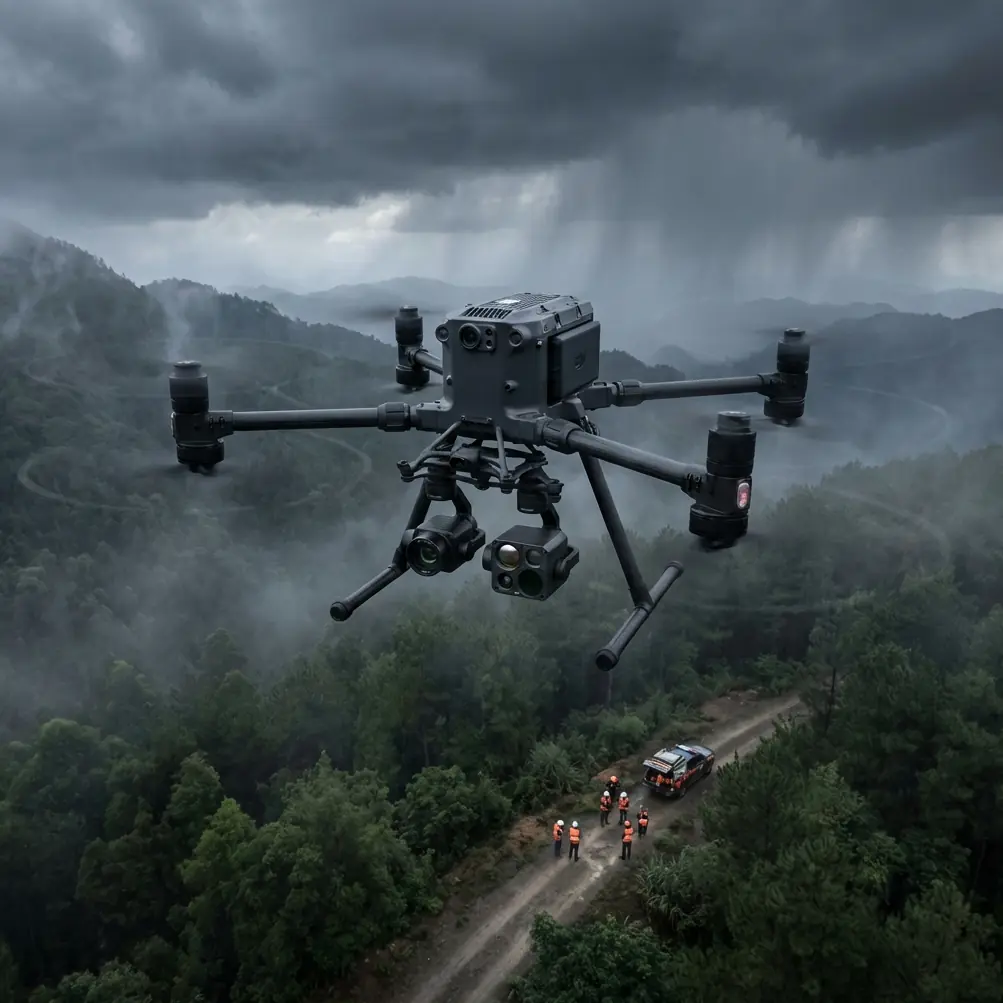
Matrice 400 in Vineyard Low-Light Operations: A Field Report on Control Integrity, Hydraulic Logic, and Range Discipline
META: Specialist field report on using Matrice 400 for low-light vineyard tracking, with practical advice on antenna positioning, control reliability, thermal workflow, and operational lessons drawn from aircraft design principles.
I’ve spent enough time around agricultural UAV programs to know that vineyard work exposes weak assumptions quickly. Rows look orderly on paper. In darkness, under uneven canopy temperature, with rolling terrain and intermittent line-of-sight, they do not. A platform like the Matrice 400 earns its place not because it flies in a brochure, but because it keeps control authority, data continuity, and operator confidence when the easy conditions disappear.
For teams tracking vineyards in low light, that distinction matters. You are not simply trying to “see at night.” You are trying to separate meaningful thermal signature changes from background cooling, maintain stable image geometry for photogrammetry, and keep a secure control link while flying long row patterns where every antenna angle and every pause at the field edge can change the quality of the mission.
This report looks at Matrice 400 through a lens that most marketing copy skips: what aircraft-system design principles tell us about reliable field performance. Two technical reference points are especially useful here. One comes from helicopter control-system structural design, where torque-arm placement, connection strength, bending loads, bolt shear loads, and fatigue details determine whether control components survive repeated motion. The second comes from hydraulic protection logic, where valves open only after pressure exceeds a defined threshold, metered flow prevents excessive leakage, and maintenance reset requires the line to be fully depressurized and left for roughly 3 to 5 minutes before the mechanism returns to normal. Those details may sound far removed from a vineyard mission. They are not. They explain how serious aircraft are engineered to remain predictable under repeated stress, and why operators should care about the “small” habits that preserve that predictability in the field.
What low-light vineyard tracking really asks of the aircraft
At dusk and pre-dawn, vineyards become more legible thermally but less forgiving operationally. Thermal contrast can reveal irrigation irregularities, stressed vines, blocked drippers, animal intrusion, and patchy canopy vigor. Yet the same conditions that improve thermal differentiation also complicate flight execution.
Ambient light drops. Visual orientation gets harder. Surface moisture may alter apparent heat patterns. Terrain features disappear. Operators start depending more heavily on the aircraft’s transmission stability, return path awareness, and disciplined mission planning. If the aircraft drifts, if the gimbal path is inconsistent, if the link degrades at the end of a long row, your thermal map loses trust fast.
That is why a Matrice 400 workflow for vineyards should not be framed as “just fly lower and use thermal.” It should be framed as a control-and-data consistency problem.
Why old aircraft design logic still matters to a modern UAV
One of the more useful references in helicopter design discusses the structural treatment of moving and fixed rings in control assemblies. The key point is not the specific hardware form. It is the engineering logic behind it.
The source notes that torque arms and anti-torque arms carry tangential loads in the ring plane, which then appear as bending moments in the supporting arms, while the connecting bolts between moving parts are subjected to shear loads. Designers are told to select appropriate load-bearing cross-sections and to control radial and axial clearance at those rotating connections strictly. It also stresses fatigue design: material choice, stress level, structural layout, manufacturing process, connection form, and load path all influence service life, with special attention to fillets and abrupt section changes.
For a vineyard operator, the significance is straightforward. In a UAV that is asked to repeat long agricultural missions, the difference between a stable aircraft and a troublesome one often comes down to how well the platform resists accumulated mechanical looseness. Low-light work amplifies the consequence of that looseness because you have less visual margin and a higher dependence on sensor trust.
This is why I tell teams to think beyond flight time and payload specs. Ask whether the airframe and gimbal ecosystem are being used in a way that respects fatigue reality. Repeated aggressive braking at row ends, hard transport handling, careless mounting of payloads, and rushed post-flight packing all contribute to the same long-term problem aircraft designers try to prevent: load concentrations and unwanted clearances where precision motion should remain tight.
In practical Matrice 400 terms, that means three things:
Watch repeatability, not just one-flight performance.
A vineyard mission that looks acceptable once may still be introducing tiny control or mounting issues that show up after twenty cycles.Protect interfaces.
Payload mounts, landing impacts, arm handling, and transport cases matter because connection points are where shear, vibration, and fatigue quietly accumulate.Take vibration seriously when judging imagery.
If thermal or visible data starts showing subtle inconsistency row to row, don’t assume it is purely environmental. Mechanical integrity is part of data integrity.
Redundancy is not decoration
The helicopter reference also makes a sharp point about the number of torque arms being a redundancy decision shaped by weight and reliability targets. That idea translates well to Matrice 400 mission planning. In civilian drone operations, redundancy is not only built into the aircraft; it also has to be built into the workflow.
For vineyard tracking, redundancy should show up in:
- overlapping image capture for photogrammetry,
- spare GCP planning where geospatial accuracy matters,
- duplicate review of thermal anomalies before acting,
- battery rotation discipline, especially with hot-swap batteries,
- and communication procedures for BVLOS or extended corridor operations where permitted.
The operational significance is simple: when one layer degrades, the mission should not collapse. If a patch of low-light imagery has marginal contrast, you should have enough overlap and enough positional confidence to recover value. If a battery change is needed between blocks, hot-swap capability reduces disruption, but only if the team’s handoff routine is orderly and repeatable.
Hydraulic protection logic offers a lesson in how to fly smarter
The hydraulic reference is equally revealing. It describes a pressure-control and metering concept where a valve remains closed in normal conditions, but once pressure at port A exceeds a specified threshold, hydraulic force overcomes spring preload, the valve opens, and high-pressure oil is released back to tank. The same source explains a metering unit that ensures a fixed volume of continuous flow from A to H to prevent excessive leakage, and notes that if the mechanism is shut closed during maintenance, pressure must be fully relieved, including tank pressurization, then left at rest for 3–5 minutes so the sliding valve can reset under spring force.
Again, the significance for Matrice 400 operations is not about copying hydraulic architecture. It is about understanding protection behavior.
Well-designed aircraft systems do not wait for failure to become dramatic. They use thresholds, controlled release, and orderly reset behavior. Vineyard pilots should adopt the same philosophy in flight operations.
That means setting your own field thresholds before the mission starts:
- maximum acceptable link degradation before turning the aircraft,
- minimum thermal contrast needed before committing to a full block scan,
- maximum wind or gust spread under low-light conditions,
- minimum satellite geometry or RTK confidence if tying the mission to GCP-backed outputs,
- and a hard rule for pausing after any system warning instead of “just finishing the row.”
The maintenance reset detail is especially relevant. In the reference, a system does not instantly become normal just because the operator wants it to. It needs pressure removed and a short wait interval. UAV teams should respect the same reality after anomalies. If the Matrice 400 has experienced an abnormal event, rushed power-cycling and immediate relaunch can hide the root cause. Give systems time. Recheck logs, payload seating, battery condition, and link environment. In the field, impatience is expensive.
Thermal signature: what to look for in vineyards
Low-light thermal work is seductive because everything appears meaningful at first glance. It isn’t. The best Matrice 400 operators do not chase every warm or cool patch. They interpret thermal signature in agricultural context.
Useful vineyard thermal patterns often include:
- elongated cool corridors suggesting irrigation distribution differences,
- localized hot spots around vine stress or bare soil exposure,
- row-end irregularities where compaction or drainage differs,
- and canopy discontinuities that align with missing plants, disease pressure, or trellis changes.
The key is consistency of capture. Fly with enough overlap to support later comparison. If you are producing orthomosaics, keep your photogrammetry assumptions realistic. Thermal mosaics can be less forgiving than visible-spectrum maps when altitude, angle, and speed vary too much. This is where GCP support still earns respect, especially when the grower wants to compare data over time rather than admire a single mission’s images.
Matrice 400 users should think of thermal and mapping as one workflow, not two separate tasks. Thermal identifies where to look. Photogrammetry, especially with proper GCP use, gives those findings location certainty.
Antenna positioning advice for maximum range
This is the part many crews underestimate.
When flying long vineyard rows, especially over undulating ground, your transmission quality can degrade even before distance becomes extreme. O3 transmission performance is strongest when antenna geometry and line-of-sight discipline are treated as mission variables rather than afterthoughts.
My field advice is uncomplicated:
- Keep the remote controller antennas oriented broadside to the aircraft, not pointed like a spear directly at it.
- Reposition your own body and controller stance as the aircraft turns onto a new row. Do not lock yourself into one static posture for the whole block.
- Avoid standing beside vehicles, metal fencing, pump enclosures, or dense utility structures that can reflect or attenuate signal.
- If the vineyard sits on rolling terrain, move to a slight high point rather than the most convenient flat spot.
- During long passes, watch not only signal bars but also latency and video smoothness. Transmission trouble often announces itself subtly first.
The operational significance here is huge. In low-light work, once visual cues weaken, the control link and downlink become your primary situational reference. Better antenna positioning can produce a more reliable margin than many operators get from changing altitude or speed.
If your team wants a field checklist for controller orientation and route setup, I usually suggest keeping one simple card in the case rather than relying on memory. If you need a direct line for that, you can message our flight support desk here.
Security and continuity matter more after dark
Vineyard operators are increasingly aware that data has value. Block health maps, irrigation irregularities, and seasonal trend records should not be treated casually. This is where secure transmission features such as AES-256 matter in a practical sense. They are not abstract IT talking points. They reduce exposure when transmitting operational imagery and georeferenced agricultural intelligence across active links.
For teams running repeated surveys across multiple estates or contract sites, secure handling also improves client confidence. The same goes for disciplined media management after landing. A secure link during flight should be matched by a secure ingest and archive process on the ground.
Hot-swap batteries and block efficiency
Hot-swap batteries are one of those features that sound convenient until you use them in agricultural production. Then they become a scheduling tool.
In vineyards, valuable low-light windows can be short. Thermal contrast often shifts quickly as ambient temperature changes and the sun approaches the horizon. A battery workflow that lets the aircraft remain mission-ready while packs are exchanged can preserve continuity across adjacent blocks. But the value is not simply less downtime. The real benefit is less disruption to mission rhythm. Crews stay focused, route logic stays intact, and you reduce the chance of relaunch errors that happen when people rush to beat changing light.
A final field note on discipline
Matrice 400 is best understood not as a bigger drone, but as a platform that rewards aviation habits. The references behind this article reinforce that point. Structural designers worry about tangential loads, bending moments, bolt shear, and fatigue because repeated motion punishes weak details. Hydraulic designers build threshold behavior and reset procedures because protection only works when systems return to a known state in an orderly way.
Those principles belong in vineyard operations too.
If you are flying low-light missions over vines, be methodical. Respect link geometry. Use thermal data as evidence, not spectacle. Support mapping with GCP when positional confidence matters. Leverage O3 transmission and AES-256 as operational tools, not feature bullets. Use hot-swap batteries to protect the time window, not to encourage haste. And after any anomaly, pause long enough to restore the aircraft to a truly known condition.
That is how Matrice 400 becomes more than capable. That is how it becomes dependable.
Ready for your own Matrice 400? Contact our team for expert consultation.