
Matrice 400 for Urban Wildlife Tracking: A Technical Review
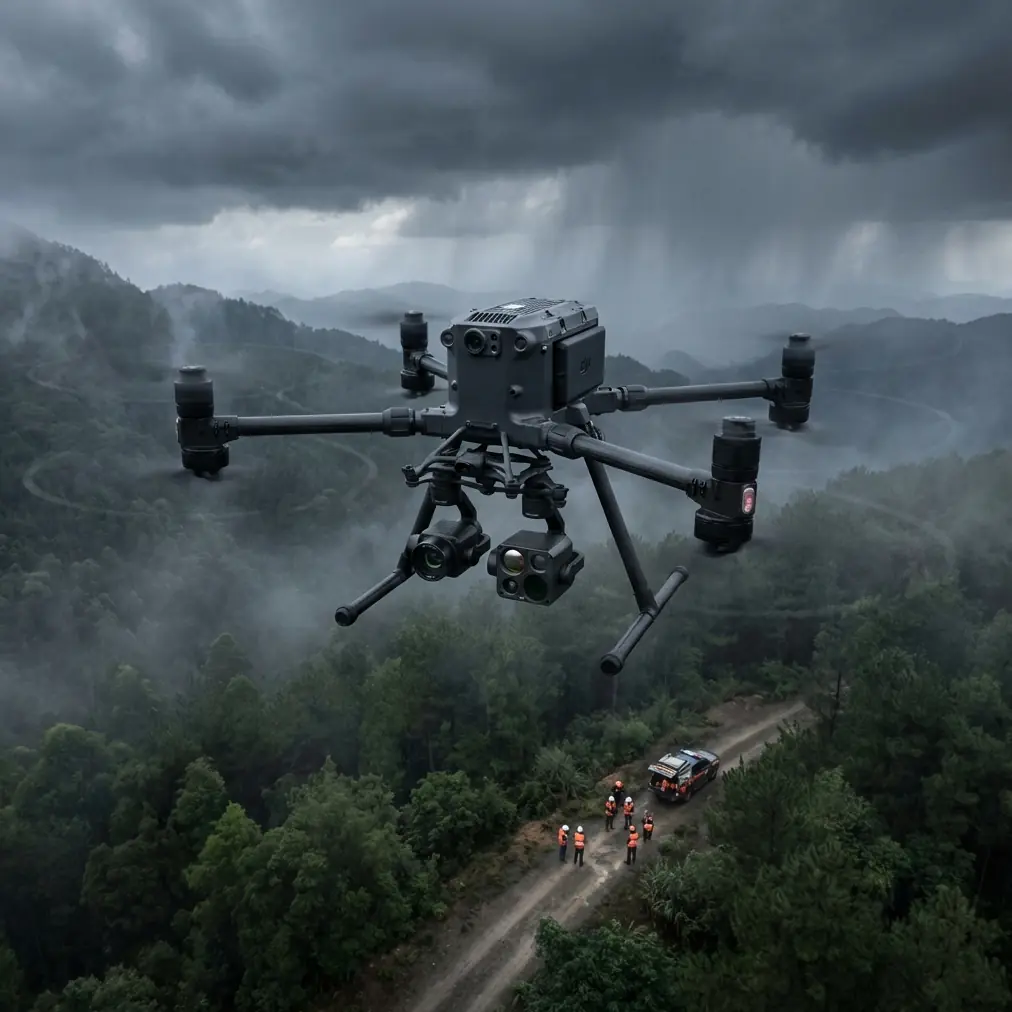
Matrice 400 for Urban Wildlife Tracking: A Technical Review from the Field
META: Expert technical review of the Matrice 400 for urban wildlife tracking, covering thermal signature detection, O3 transmission, AES-256 security, hot-swap batteries, BVLOS workflows, photogrammetry, GCP strategy, and useful third-party accessories.
Urban wildlife work is messy in ways spec sheets rarely admit.
Animals do not move on cue. Rooftops distort line of sight. Tree cover breaks visual continuity just as a fox, macaque, deer, boar, or stray dog crosses from parkland into alleys, drainage corridors, rail edges, and industrial lots. The aircraft you choose for this job has to do more than simply stay in the air. It has to hold a reliable link in difficult RF conditions, support thermal work at dawn and dusk, protect sensitive location data, and keep crews moving without forcing a full shutdown every time batteries run low.
That is where the Matrice 400 becomes interesting.
This is not a generic platform discussion. For urban wildlife tracking, the value of the Matrice 400 sits in the way several capabilities work together: long-range O3 transmission for maintaining situational awareness in dense environments, AES-256 encryption for protecting geospatial and video data tied to vulnerable species, hot-swap battery architecture for continuity during extended observation windows, and mission flexibility when teams need both thermal detection and photogrammetry outputs in the same deployment cycle.
If your work involves monitoring animal movement in city-edge habitats, documenting nest activity on inaccessible structures, or building orthomosaics of green corridors to understand movement patterns, the M400 class platform offers something many lighter aircraft cannot: operational depth.
Why urban wildlife tracking is harder than it sounds
Open-country wildlife surveys and urban wildlife surveys are not the same discipline.
In a city or peri-urban setting, the mission often begins with uncertainty. You may have fragmented reports from residents, a rough time window for animal activity, and incomplete knowledge of how the species is using the built environment. A drone is useful here only if it can pivot between search, verification, documentation, and repeat observation.
That means one flight may start as thermal detection over a drainage basin, continue as visual confirmation over rooftops, then finish with a mapping pass to document habitat features around feeding routes. In practical terms, the platform must support more than “finding the animal.” It must support evidence.
The Matrice 400’s appeal in this context is not one single headline feature. It is the stack.
O3 transmission matters more in cities than on the spec sheet
Many operators look at transmission systems as a comfort feature. In wildlife work, especially urban wildlife work, they are an operational backbone.
O3 transmission is significant because urban environments are full of obstacles that interrupt clean signal paths: apartment blocks, utility structures, warehouses, mature trees, bridge decks. Even when the aircraft remains legally within the operator’s approved mission framework, those obstacles can degrade video confidence and command reliability. For tracking a moving animal, confidence in your downlink is not a luxury. It shapes whether you continue to monitor the subject smoothly or lose continuity at the exact moment it crosses into a more complex area.
With the Matrice 400, O3 transmission supports a more stable working picture when animals transition between open grass, roadsides, and built-up zones. That has direct field value. A team monitoring urban deer movement near expressways, for example, may need to observe direction changes in real time to coordinate with ecologists or municipal stakeholders. A weak or unstable link can turn a live tracking task into guesswork.
The deeper point is this: reliable transmission reduces interpretation errors. When the thermal blob disappears behind a retaining wall or a row of parked vehicles, the crew needs to know whether the animal changed direction or the link quality fell apart. Better transmission performance helps answer that.
Thermal signature detection changes the pace of a mission
Urban wildlife surveys often happen during the least convenient hours: before sunrise, after sunset, or in low-light transitions when human activity drops and animal activity rises.
Thermal signature work is the obvious answer, but urban thermal interpretation is full of traps. HVAC exhausts, warm roofing materials, vehicle engines, concrete heat retention, and even vent stacks can create clutter. The airframe alone does not solve this. Still, a platform like the Matrice 400 earns its keep by carrying the right thermal payload consistently and keeping the mission active long enough to interpret what the sensor is showing.
That persistence matters.
A fox moving across a residential edge might appear briefly between parked cars, then vanish under tree cover. A colony of roosting birds on a large industrial structure may only present clear signatures from one angle due to background heat. A heavier-duty platform gives the team time to orbit carefully, compare angles, and avoid premature conclusions.
This is where operational discipline beats spectacle. Thermal data should not be treated as proof on first glance. On the M400, the practical workflow is to use thermal for cueing, then verify with visible imagery, location context, and movement behavior. That reduces false positives and protects data quality, especially if findings will feed into ecological reporting or mitigation planning.
AES-256 is not a brochure detail in wildlife operations
People tend to associate encrypted links with enterprise IT checklists. In urban wildlife work, AES-256 has real field significance.
Sensitive location data can be a conservation issue. Nest sites, den entrances, roost locations, and habitual feeding areas can all become problematic if footage or map data circulates loosely. Even when the species itself is common, the datasets may contain private-property imagery, infrastructure details, or citizen-sensitive locations.
AES-256 encryption matters because wildlife missions are increasingly data-heavy and multi-stakeholder. Footage may pass between drone crews, environmental consultants, municipal planners, facility managers, and researchers. Security at the transmission layer helps reduce exposure while data is being captured and relayed.
That is not abstract. If a team is documenting bat access points on urban buildings or tracking repeated visits by civets, otters, or boar through semi-public corridors, controlling who can intercept or access live data becomes part of professional practice. The Matrice 400’s secure transmission profile is one of those features that sounds administrative until you work on a sensitive site. Then it becomes essential.
Hot-swap batteries are a workflow advantage, not just convenience
Wildlife movement rarely lines up with battery cycles.
A platform with hot-swap batteries changes the rhythm of a survey day because crews can keep critical systems active during battery replacement instead of powering down and rebuilding the mission state from scratch. That has obvious value during long observation windows, but the real advantage appears in edge cases.
Imagine you are monitoring repeated crossings through a narrow green belt between logistics buildings and a canal embankment. Activity has been irregular all morning, then starts to intensify just as remaining battery margin becomes uncomfortable. On an aircraft without hot-swap support, the crew faces a poor choice: terminate and lose continuity, or push too close to reserve. On the Matrice 400, hot-swap batteries reduce that disruption.
For urban wildlife tracking, continuity is data quality. If you are trying to confirm whether the same animal uses the same route at 20-minute intervals, interrupted coverage weakens the story your data can tell. The battery architecture supports better observation discipline.
BVLOS thinking changes mission design, even when approvals are limited
BVLOS is one of those terms people throw around too casually. In reality, operational approval frameworks vary widely, and responsible teams build missions around local rules and risk assessments. Still, BVLOS capability thinking matters because it influences how a platform is integrated into larger monitoring programs.
Why does that matter for wildlife work?
Because urban wildlife tracking increasingly extends beyond a single park or parcel. Movement corridors can span waterways, utility easements, road verges, rooftops, vacant lots, and institutional campuses. A drone platform suited to BVLOS-aligned workflows tends to be more robust in communication, redundancy, and mission planning. Even where flights remain within the approved visual framework, that design philosophy benefits the operator.
The Matrice 400 fits programs that need repeatable corridor observation rather than isolated one-off flights. If your organization is building a seasonal movement dataset instead of just responding to sightings, platform reliability becomes more valuable than flashy portability.
Photogrammetry and GCPs: the overlooked half of wildlife tracking
Tracking wildlife is not only about finding animals. Often, the bigger long-term value lies in understanding habitat structure and route selection.
This is where photogrammetry on the Matrice 400 deserves more attention. Urban ecology teams can use the same platform not just for detection but for generating high-resolution site models of parks, drainage basins, waterfront edges, rail verges, and fragmented woodland pockets. Those models become powerful when paired with GCPs.
Ground control points are not glamorous, but they dramatically improve positional consistency in repeated surveys. If you are trying to measure changes in canopy cover, informal trail development, fence gaps, or rooftop access pathways over time, GCP-backed mapping gives you a defensible base layer. That can help explain why animal movement changes from one month to the next.
For example, a thermal mission might reveal repeated nocturnal activity near a stormwater channel. A follow-up photogrammetry mission with well-placed GCPs can produce a more accurate map of embankment geometry, vegetation density, culvert access, and nearby human barriers. That turns sightings into spatial analysis.
The Matrice 400 is well suited to this sort of dual-role work because it supports a workflow broader than “fly, spot, land.” It can sit inside a proper survey program.
A third-party accessory that genuinely helps: high-output spotlight integration
Most accessories are situational. One that can make a real difference in urban wildlife operations is a well-integrated third-party spotlight, used carefully and ethically.
That may sound counterintuitive in wildlife work, and there are obvious situations where illumination would be inappropriate. But for selected missions—especially recovery of tagged domestic animals, post-survey site exit checks, inspection of roost-adjacent structures after thermal verification, or low-light navigation around complex obstacles—a controlled, mountable third-party spotlight can improve visual confirmation without forcing the crew to rely on high ISO visible imaging alone.
The key is restraint. The spotlight should not be used to harass or pressure wildlife. It should be applied briefly, at the right distance, and only when the mission objective and species sensitivity justify it. On a stable aircraft like the Matrice 400, that kind of accessory integration can improve target verification after thermal detection, particularly around rooftop voids, bridge elements, or service corridors where visible detail is poor.
If your team is evaluating accessories or payload combinations for this role, it is worth discussing mission specifics with an integrator who understands the platform rather than treating lighting as a generic add-on. A practical starting point is to message a drone integration specialist.
Where the Matrice 400 fits best
The Matrice 400 makes the most sense for urban wildlife teams that need endurance, repeatability, and sensor flexibility more than they need ultra-light deployment.
It is a strong fit for:
- environmental consultants monitoring movement corridors near development sites
- university or NGO research teams conducting repeated observation over mixed urban habitats
- facility managers dealing with wildlife presence across large campuses or industrial estates
- ecological survey crews combining thermal detection with map-grade site documentation
- training organizations building advanced civilian workflows around thermal interpretation, secure operations, and structured data capture
It is less about novelty and more about reducing operational compromise.
Final assessment
The best argument for the Matrice 400 in urban wildlife tracking is not that it can do everything. It is that it reduces the number of trade-offs that usually weaken wildlife data.
O3 transmission improves confidence when animals move through signal-hostile city terrain. AES-256 helps protect sensitive imagery and location data. Hot-swap batteries preserve continuity during long observation windows. Thermal workflows become more practical when the platform can hold position and support verification rather than just detection. Photogrammetry with GCP-backed control turns sightings into spatial intelligence. And carefully selected third-party accessories can extend usefulness when conditions demand more than the base setup.
For teams working in the real world of urban ecology—where habitats are fragmented, stakeholders are many, and evidence has to stand up after the flight—that combination is what gives the Matrice 400 its value.
Ready for your own Matrice 400? Contact our team for expert consultation.