
Matrice 400 tracking tips for urban wildlife
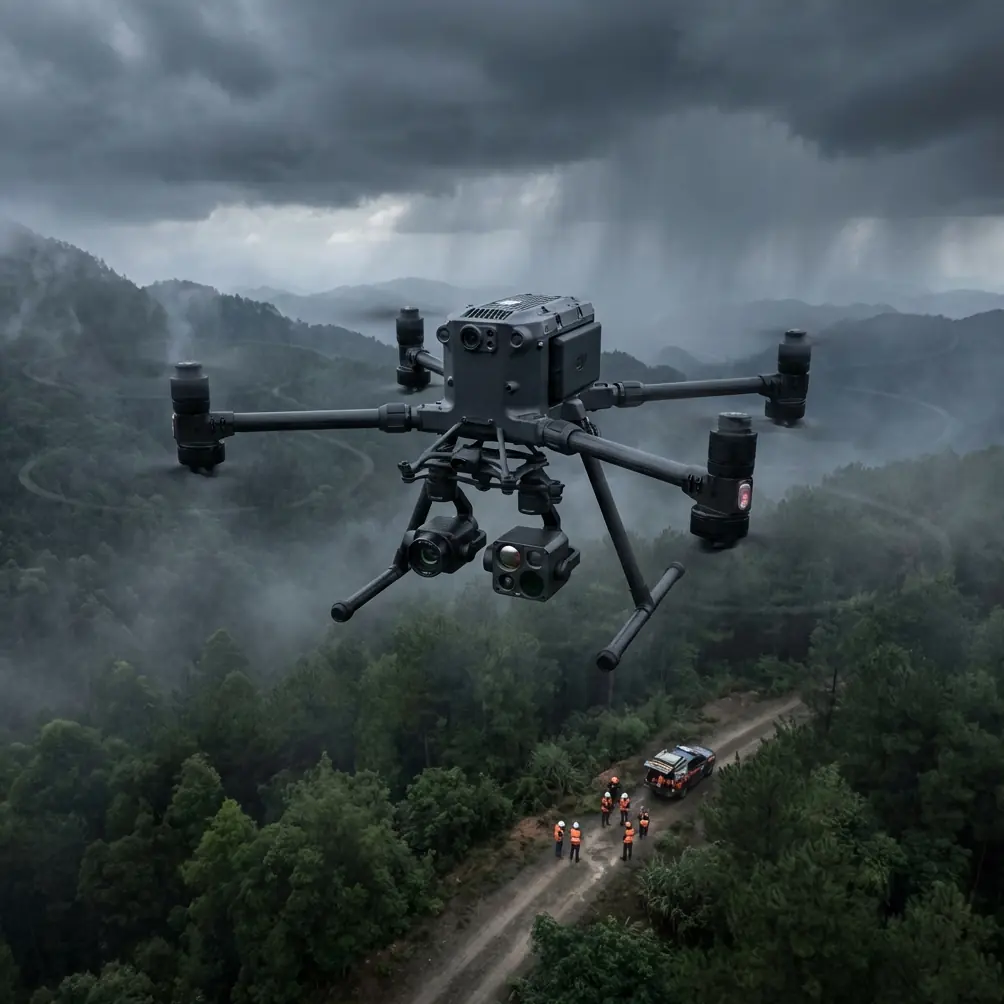
Matrice 400 tracking tips for urban wildlife: what actually matters in the field
META: A practical expert guide to using Matrice 400 for urban wildlife tracking, with real insight on payload power planning, thermal workflow, transmission reliability, and fatigue-aware mission design.
Urban wildlife work punishes weak assumptions.
Tracking foxes along rail corridors, monitoring roosting birds on warehouse roofs, or following feral hog movement at the edge of industrial parks all sound straightforward until the aircraft is airborne. Signal reflections bounce off glass. Heat from HVAC systems contaminates a thermal scene. Flight legs become stop-start because the target disappears under bridges, trees, or loading bays. And the drone that looked perfect on a spec sheet suddenly feels less capable when the mission stretches longer than expected.
That is where the Matrice 400 deserves a more technical conversation.
I’m not interested in treating it as just another enterprise platform with a bigger battery and a cleaner brochure. For urban wildlife tracking, the real value of a system like the Matrice 400 comes from how well it tolerates uneven mission loads: changing payload demand, extended hover periods, repeated sorties, thermal sensing, photogrammetry passes for habitat context, and secure transmission in cluttered urban airspace. Those are engineering problems before they become wildlife problems.
This guide is built around that reality.
Start with the mission, not the aircraft
A common mistake in wildlife operations is choosing settings based on isolated features. Operators obsess over thermal signature detection, O3 transmission stability, or hot-swap batteries as if each item lives on its own. In practice, urban tracking is a chain. If one link is weak, the whole mission degrades.
With a Matrice 400 workflow, I recommend defining the job in three layers:
- Detection: spotting the animal or heat source in clutter
- Context: understanding where that movement sits in the landscape
- Persistence: staying on station long enough to confirm behavior without unnecessary relaunches
The aircraft has to support all three without creating avoidable risk or workflow friction.
Why payload power planning matters more than most pilots think
This is one area where aviation design logic is surprisingly useful for drone operators.
In aircraft electrical system design, once the major loads are known, engineers validate supply power against actual equipment demand rather than relying on rough initial assumptions. One reference rule states that when AC is the main power source, DC power can be preliminarily selected at 10% of the main source rated capacity. That is not a drone sizing formula you should copy blindly, but the principle matters: auxiliary power assumptions need to be grounded in real mission loads.
For Matrice 400 urban wildlife work, this translates into a simple discipline. Do not build your mission around the aircraft alone. Build it around the complete electrical and thermal stack:
- flight controller and propulsion demand
- thermal payload demand
- visual sensor demand
- transmission workload
- onboard recording
- any lighting or auxiliary devices allowed within your civilian operating framework
Why does this matter operationally?
Because urban tracking missions often combine payload states that are not constant. A thermal camera may be doing the heavy lifting at dawn, then the mission shifts to visible imaging for species confirmation or photogrammetry of habitat corridors. If you do not map those demand peaks in advance, your endurance planning becomes optimistic. The Matrice 400 may be more capable than many competing enterprise platforms, but that does not exempt the pilot from load analysis.
Another design rule from aircraft power engineering is even more relevant: the largest single electrical load should stay below 40% of one system’s capacity. Again, that exact threshold belongs to aircraft system design, not directly to a field checklist for UAVs. But as a planning mindset, it is excellent. If one payload mode dominates the aircraft’s practical energy or processing headroom, the entire mission becomes fragile. You lose resilience when conditions change.
For wildlife teams, resilience is everything. Animals do not move on cue.
Thermal signature work in cities is harder than in open countryside
Urban wildlife tracking is not simply “find the hottest thing.”
Buildings leak heat. Asphalt stores heat. Parked vehicles, exhaust vents, rooftop equipment, and sun-warmed masonry all produce false positives. The Matrice 400’s advantage is not just that it can carry a strong thermal payload, but that it supports a more disciplined sensing workflow over time.
That matters because a good thermal operator is really comparing patterns, not just spotting bright pixels.
A fox moving through an alley at dawn has a different thermal behavior from a static vent. A bird cluster on a rooftop edge creates a different signature shape than ducting. A raccoon crossing a wall line gives you transient contrast and motion cues that become easier to interpret when the aircraft can maintain stable observation and reliable transmission.
This is where Matrice 400 can outperform lighter competitors that feel agile in short demonstrations but become compromised in real urban observation. If your platform forces frequent landings, degraded video confidence, or payload compromises, you lose continuity. And continuity is what helps separate wildlife from infrastructure noise.
Use photogrammetry for tracking, not just mapping
Many teams treat photogrammetry as a separate deliverable. That is a missed opportunity.
In urban wildlife projects, photogrammetry can provide the environmental context that makes thermal detections meaningful. A repeated map of rooftops, drainage paths, service lanes, tree cover, fences, and gap corridors can reveal why animals move the way they do. If you are using GCP-backed site control where appropriate and lawful, the resulting model can be accurate enough to compare changes over time with real operational value.
For example:
- Has a construction barrier redirected a known movement route?
- Has vegetation removal exposed a nesting area?
- Has waste access near a commercial block shifted wildlife congregation patterns?
The Matrice 400 is well suited to this dual-role workflow because it can support both tracking sorties and structured capture missions without feeling like a compromise platform. That is not just convenience. It reduces fleet fragmentation. One aircraft can support thermal observation, visible confirmation, and site modeling with fewer handoff issues.
In dense urban areas, that consolidation is an advantage over platforms that are strong in either inspection-style hover work or mapping-style capture, but not both.
Battery strategy should match the animal’s behavior window
Hot-swap batteries sound like a convenience feature until you are tracking movement windows that last only a few minutes.
In urban wildlife operations, those windows often occur at transition periods: first light, dusk, post-rain activity, refuse collection hours, or late-night quiet periods when species emerge into built-up areas. If your drone has to shut down the mission state or drag out turnaround time, you can miss the exact behavioral moment you needed to document.
That is why hot-swap capability is not just about uptime. It is about preserving the continuity of your mission logic.
You should still treat battery planning conservatively. In conventional aircraft electrical system design, engineers expect capacity margin in the 35% to 50% range, with 15% as a practical minimum floor, and civil platforms are expected to carry more margin than aggressive tactical designs. For Matrice 400 operators in wildlife work, that principle is spot on. Civilian conservation and survey missions should not be flown on razor-thin energy assumptions.
Operationally, that means:
- plan for reserve, not just nominal endurance
- account for hover-heavy observation segments
- include reroute penalties caused by urban obstacles
- assume additional time for reacquisition after temporary target loss
The teams that get the best outcomes are usually the least romantic about battery claims.
Transmission quality changes the ethics of observation
Urban wildlife tracking is partly a technical challenge and partly an ethical one. You want usable evidence without pushing the aircraft into awkward, intrusive repositioning.
Reliable O3 transmission helps because it reduces the temptation to “chase the picture.” If the downlink remains stable and clear, the pilot can hold a more measured standoff, especially around sensitive roosts, den approaches, or rooftop nesting areas. Poor link confidence often causes overcorrection: climbing, shifting, or closing distance when patience would have been better.
Security also matters when wildlife projects involve sensitive site data, protected species locations, or access routes through private infrastructure. AES-256 level transmission protection is not marketing garnish in those cases. It supports better data governance when your mission covers ecologically sensitive populations in commercially sensitive places.
If your team is building a city biodiversity program or contracted monitoring framework and needs help setting up a secure field workflow, you can reach us on this project planning channel.
Think about fatigue, not just flight time
One of the most overlooked ideas in drone operations comes from structural fatigue analysis.
A reference on aircraft load-path iteration describes a direct iterative method where the full load is applied at each calculation, then the system is updated repeatedly as elements entering plastic behavior change their flexibility. The process continues until the load transfer difference between two successive calculations falls below an error threshold, often in the range of 0.01 to 0.1, or a very small fraction of maximum load. In plain language: you do not assume the structure behaves the same way after stress accumulates. You recalculate until the model stabilizes.
That mindset is incredibly useful for Matrice 400 wildlife operations.
No, your field team is not running rivet-plasticity equations before a dawn survey. But repeated urban missions create a similar management problem: the aircraft system does not live in a pristine, one-flight world. It experiences cumulative stress through repeated takeoffs, rooftop turbulence, braking events, wind shear between buildings, payload changes, and long hover segments.
A serious operator should therefore use an iterative maintenance mindset:
- review flight logs after each urban campaign
- watch for changes in vibration trends
- inspect landing gear and payload mounting points regularly
- track battery health by mission profile, not just cycle count
- evaluate whether specific route types are increasing wear
This is one place where Matrice 400’s more robust enterprise orientation can justify itself against smaller competitors. Lightweight systems may complete the same mission once. The question is what happens after repeated sorties in dense urban air, under demanding observation profiles, with thermal payloads attached and tight scheduling pressure. Durability is not glamorous, but it is central to reliable wildlife work.
A practical mission template for urban wildlife tracking
Here is a field-tested structure I would use with a Matrice 400.
1. Pre-build the habitat model
Run a visible-light photogrammetry capture of the area first. Use GCPs where your project requires higher positional confidence. Generate a map that highlights likely movement corridors, warm infrastructure, roof access points, and concealed transition zones.
2. Define thermal trap zones
Before launch, mark the locations most likely to produce misleading heat signatures:
- HVAC clusters
- vent outlets
- parked service vehicles
- exposed asphalt patches
- reflective roof edges
This reduces time wasted on false positives.
3. Schedule around behavior, not daylight alone
Dawn and dusk are obvious, but urban species often respond more strongly to noise patterns, traffic lulls, waste handling windows, and human activity shifts.
4. Fly for persistence first
Use the Matrice 400’s endurance and battery management strengths to hold observation angles that minimize disturbance. Do not burn energy on unnecessary repositioning early in the sortie.
5. Confirm with mixed sensing
Thermal detects. Visible confirms. Mapping explains. That sequence is more reliable than trying to force one payload mode to do everything.
6. Review for cumulative stress
After repeated missions over the same district, inspect the aircraft with the same seriousness you would apply to any professional work platform exposed to cyclical load and vibration.
Where Matrice 400 stands out
The urban wildlife niche exposes weaknesses quickly. Some drones are portable but too compromised for persistent multi-sensor observation. Others are stable but awkward when the mission shifts from thermal watch to mapping or from one launch window to another. The Matrice 400 stands out because it is better aligned with how real fieldwork unfolds: unevenly, iteratively, and under changing load conditions.
That is the thread connecting all of the technical details above.
- Electrical planning matters because payload reality beats brochure assumptions.
- Capacity margin matters because civilian operations need conservative resilience.
- Thermal performance matters because cities are full of heat noise.
- Hot-swap workflow matters because behavior windows are brief.
- Secure transmission matters because sensitive ecological data travels across urban infrastructure.
- Fatigue-aware operation matters because repeated missions reveal the truth about platform suitability.
If you approach the Matrice 400 as a complete mission system rather than a flying camera, it becomes much easier to understand why it is such a strong fit for wildlife tracking in urban environments.
And if you ignore those interactions, even a very capable aircraft will underperform.
Ready for your own Matrice 400? Contact our team for expert consultation.