
Matrice 400 for Wildlife Tracking in Low Light
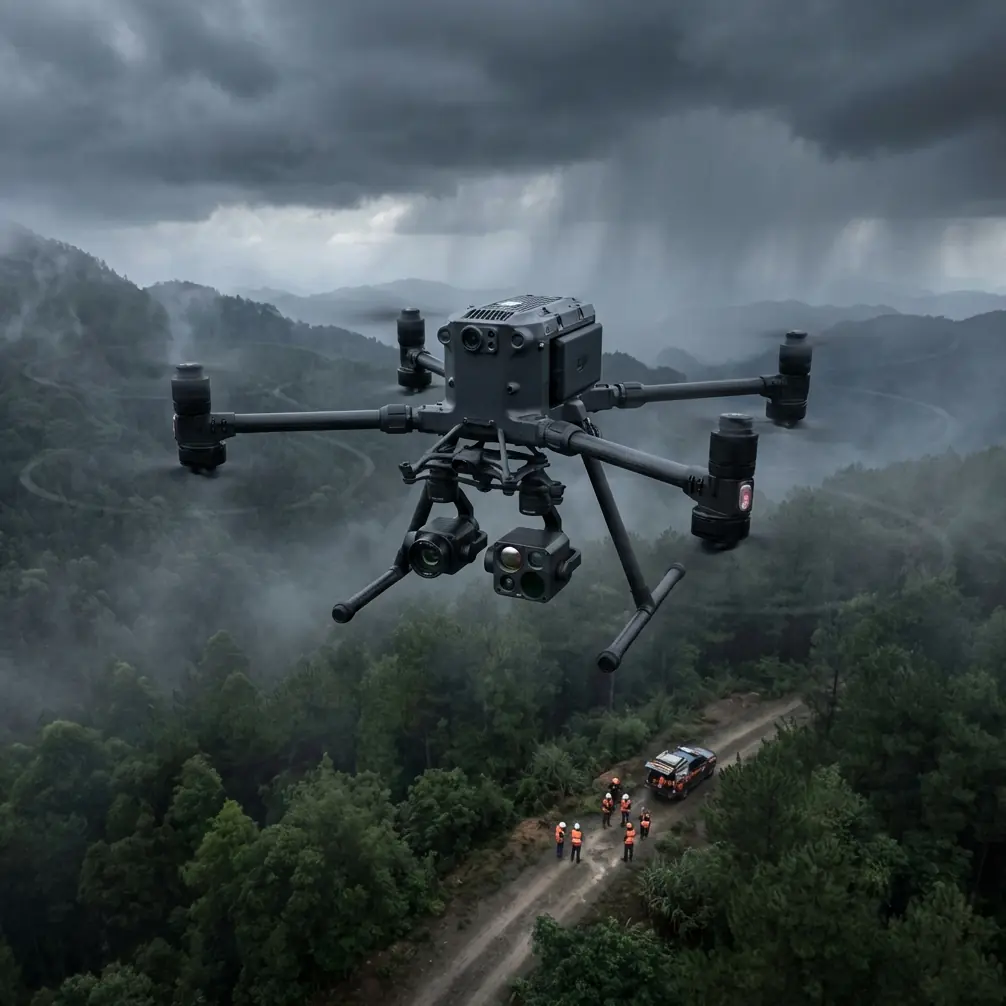
Matrice 400 for Wildlife Tracking in Low Light: A Field Tutorial on Structure, Interference, and Safer Night Operations
META: Expert tutorial on using Matrice 400 for low-light wildlife tracking, with practical guidance on thermal signature work, electromagnetic interference handling, O3 transmission stability, hot-swap battery planning, and mission design informed by aircraft structural and fuel-system engineering principles.
I’m Dr. Lisa Wang, and when teams ask me about using a Matrice 400 for wildlife tracking at dusk, at first light, or under full darkness, they usually expect a camera conversation. Thermal settings. Lens choice. Transmission range. Maybe BVLOS workflow.
Those matter. But the teams that operate smoothly in the field usually understand something deeper: low-light tracking is not just a payload problem. It is a systems problem. Structure, materials, signal discipline, electrical behavior, weather, mission timing, and crew coordination all shape whether you get clean thermal detections or come home with noisy footage and uncertain observations.
This tutorial is built around that operational reality.
Why low-light wildlife tracking pushes the aircraft harder than daytime work
Wildlife missions in low light are unforgiving because the environment removes visual margin. At noon, a pilot can often compensate for weak planning with direct line of sight, terrain awareness, and broad visual context. At night, every weakness becomes obvious.
You depend more on:
- stable airframe behavior
- reliable transmission
- precise antenna orientation
- predictable battery changeovers
- disciplined crew communication
- payload settings tuned for thermal signature separation rather than pretty imagery
The Matrice 400 platform is attractive here because it sits in the category where mission endurance, payload flexibility, transmission quality, and professional workflow begin to work together rather than against each other. Still, the aircraft is only as good as the method wrapped around it.
That is where aerospace design logic becomes useful.
Start with a structural mindset, not just a flight checklist
One of the most valuable ideas from classical aircraft engineering is that advanced composite structure design is never separated from material and process knowledge. The source material behind this article makes that point very clearly: in composite structures, the “material” is not treated as something fixed and off-the-shelf in the old metal-aircraft sense. The structure and the material process are developed together, which means designers must work closely with materials and manufacturing specialists.
That principle matters for Matrice 400 operators more than many realize.
Why? Because field users often treat the drone as a sealed black box. For wildlife work, that mindset leads to poor decisions. A professional operator should think in terms of structural system behavior:
- where vibration enters the frame
- how payload mounting influences image stability
- how environmental moisture and temperature affect performance consistency
- how transport, assembly, and repeated deployment can alter alignment or fit
If you are flying repeated night surveys over wetlands, forest edges, or rocky terrain, your payload is only one part of the sensing chain. The aircraft’s structural integrity and assembly discipline directly affect thermal readability. A minor mounting issue can soften thermal edges enough to make a resting animal blend into a background patch. That is not a camera failure. It is a systems failure.
The same engineering source notes that mature aircraft applications most commonly rely on resin-based carbon-fiber composites. Operationally, that matters because carbon-fiber-rich aircraft structures deliver stiffness and weight advantages, but they also demand respect in handling, repair decisions, and accessory installation. If your Matrice 400 field kit includes custom brackets, lighting aids, tracking beacons, or transport fixtures, avoid improvisation that loads the frame in unintended ways. Night wildlife teams often travel far, deploy fast, and accept “good enough” hardware mounting. That habit eventually shows up as unstable footage or maintenance issues.
Low light means thermal discipline, not thermal dependence
Thermal imaging is central to wildlife tracking, but it should not be romanticized. A thermal signature is not a species identification tool by itself. It is a detection layer.
Your Matrice 400 workflow should therefore separate the mission into three phases:
- Detection
- Verification
- Recording and mapping
At the detection stage, fly for contrast, not cinematic composition. In many habitats, the best thermal contrast windows are short. Open ground after sunset may hold heat differently than vegetation. Rock, water, and man-made surfaces can all complicate interpretation. The thermal sensor helps you find anomalies; your crew process determines whether those anomalies become useful observations.
Verification may involve switching zoom, adjusting altitude, changing viewing angle, or briefly pausing movement to let the scene settle. If your payload configuration supports visible-light confirmation, use it carefully and only when it will not compromise the mission or disturb animals.
Recording and mapping come last. This is where photogrammetry and GCP planning sometimes enter the conversation. For pure wildlife tracking, you do not always need a classic mapping workflow. But if the project involves habitat documentation, den location recording for conservation teams, or repeatable corridor analysis, tying detections to mapped ground references can turn a one-off spotting mission into a meaningful monitoring dataset.
Handling electromagnetic interference: the antenna adjustment habit that saves missions
The field problem I see most often with Matrice-class aircraft in low-light operations is not battery anxiety. It is signal complacency.
People assume a professional platform with O3 transmission will sort everything out. O3 is robust, but low-light wildlife work often happens in exactly the kinds of places that create transmission quirks: ridgelines, tree cover, damp air layers, utility corridors near habitat edges, and mobile command setups with too many electronics running at once.
When interference appears, many pilots make the wrong first move. They climb, panic, and overcontrol.
The better move is usually this: stop forcing the aircraft through noise and fix the geometry.
My practical antenna adjustment sequence
If the Matrice 400 shows unstable transmission quality or image breakup near a survey zone, I coach crews through this order:
1. Hold position if safe.
Do not stack extra variables onto a signal problem.
2. Reassess controller orientation.
The antenna pattern matters. Many operators point the controller itself at the aircraft as if it were a flashlight. That often degrades link quality. Adjust the antenna faces so they present the strongest orientation to the aircraft’s position rather than simply aiming the controller body forward.
3. Change your body position by a few meters.
This sounds trivial. It is not. Vehicles, fencing, wet foliage, slope breaks, and portable electronics can all alter local RF behavior.
4. Elevate the ground station setup if possible.
Even a modest improvement in line-of-sight geometry can clean up the link.
5. Rotate the aircraft slightly or back it out of the cluttered corridor.
You are trying to restore a healthier propagation path, not win a battle against interference.
This matters especially in wildlife missions because thermal detections often happen near topographic or vegetative edges where radio conditions are less forgiving. The wrong antenna setup can turn a strong O3 link into a frustrating intermittent one.
If your team is planning recurring conservation surveys and wants help building a dependable field checklist, I sometimes share setup notes directly through this WhatsApp channel for mission coordination.
Weather affects more than visibility
One of the engineering references behind this article discusses how environmental conditions influence electrostatic behavior in fuel systems. While the original context is aircraft fuel-tank fire design, the operational lesson is broader and useful: atmosphere matters in hidden ways.
The reference describes measured differences where fuel-surface charge before typhoons and cold fronts was about 12 times the level observed after those systems had passed. It also points out that humidity changes electrical behavior, with higher moisture generally reducing charge accumulation.
You are not operating a fuel tank in a Matrice 400 wildlife mission, but the significance is still practical. Weather fronts and moisture shifts can change the behavior of the whole operational envelope:
- transmission consistency
- atmospheric clarity for thermal sensing
- battery performance
- crew perception of aircraft response
- confidence in repeatability from one sortie to the next
This is one reason I advise teams not to compare thermal outcomes across nights too casually. A route that worked beautifully two evenings ago may perform differently tonight even with the same aircraft, crew, and target species. Moisture, air layering, and recent weather movement can alter both thermal contrast and signal behavior.
The lesson is simple: do not treat environmental variation as background noise. Record it. Build it into your interpretation.
Hot-swap batteries and mission continuity
Low-light wildlife tracking often rewards continuity. Animals move. Thermal signatures appear briefly and disappear behind canopy, brush, or terrain. If you break the mission rhythm every time you change batteries, your data quality suffers.
That is why hot-swap battery workflow matters on a Matrice 400-class operation. Not because the feature is convenient, but because it protects mission continuity.
A good battery procedure should include:
- a named battery manager on the crew
- battery sets logged by cycle and temperature exposure
- a swap sequence rehearsed before night operations
- immediate post-swap sensor verification
- a rule for whether the aircraft returns to the previous observation point or shifts to a new search pattern
Hot-swap capability helps reduce downtime, but only if the team treats it as a continuity tool. Otherwise it becomes just another technical feature on paper.
Where AES-256 and BVLOS fit into conservation work
For wildlife organizations, reserve managers, and ecological consultants, data handling can be sensitive even when the mission is entirely civilian. Nesting areas, migration corridors, breeding zones, and locations of vulnerable species should not be casually exposed.
That is where secure transmission and workflow discipline matter. If your Matrice 400 operation uses AES-256-secured links or related protected data pathways, the benefit is not abstract cybersecurity jargon. It is practical habitat stewardship. Sensitive location data should be limited to the teams who need it.
BVLOS enters the discussion only when the mission profile, local regulations, and operational approvals support it. In large conservation areas, BVLOS can transform coverage efficiency, especially for corridor monitoring or wide-area thermal sweeps at dawn and dusk. But BVLOS should never be treated as a shortcut around planning. For low-light wildlife work, it raises the standard for route design, lost-link procedure, observer coordination, and landing contingency.
A smarter template for Matrice 400 wildlife sorties
Here is the mission structure I recommend most often.
1. Pre-field planning
Define the biological question first. Are you counting animals, locating movement paths, checking habitat use, or trying to verify presence in a specific zone? The flight plan must answer that question, not merely produce footage.
2. Environmental read
Log humidity, temperature trend, recent front activity, precipitation history, and surface conditions. These factors can influence thermal contrast and signal performance enough to affect data interpretation.
3. Structural and payload inspection
Treat the aircraft as a sensing platform, not a flying camera mount. Check fasteners, mounts, gimbal stability, landing gear condition, and transport-induced shifts. Composite-rich structures reward careful handling and punish casual assumptions.
4. Transmission setup
Before launch, verify controller and antenna orientation for the expected route. If operating near forest edge, ravine, power infrastructure, or metallic structures, pre-plan alternate pilot positions.
5. Thermal-first search pattern
Fly broad passes that maximize detection probability. Adjust altitude and speed to preserve thermal discrimination instead of chasing visual composition.
6. Verification protocol
Once a signature is found, establish a standard method for confirming whether it is wildlife, livestock, residual ground heat, or a false positive.
7. Mapping and documentation
If the mission requires repeatability, record coordinates, altitude, viewing angle, habitat notes, and if relevant, tie the record into a photogrammetry workflow with GCP support for later analysis.
8. Battery continuity plan
Use hot-swap procedures to minimize interruption and preserve situational awareness.
9. Post-flight interpretation
Review detections against weather and signal notes. A weak observation is sometimes a method issue, not an ecological finding.
The deeper lesson from aerospace engineering
The two technical references behind this article come from manned aircraft design, and at first glance they may seem far removed from a Matrice 400 in a wildlife reserve. They are not.
One teaches that advanced structures cannot be designed intelligently unless materials and processes are understood together. The other shows that environmental electrical behavior can shift dramatically with changing atmospheric conditions, down to measured differences as large as a 12-fold change in charge levels around major weather events.
Bring those lessons into drone operations, and your wildlife workflow gets better fast.
You stop thinking of low-light tracking as a camera exercise.
You start treating it as applied aircraft systems work.
That shift is where better results usually begin.
Ready for your own Matrice 400? Contact our team for expert consultation.