
Matrice 400 RTK: Conquering Mountain Peak Inspections When Every Minute of Battery Life Counts
Matrice 400 RTK: Conquering Mountain Peak Inspections When Every Minute of Battery Life Counts
TL;DR
- The Matrice 400 RTK delivers 55 minutes of flight time with hot-swappable batteries, enabling continuous inspection operations across challenging alpine terrain without returning to base camp
- IP45 weather resistance and six-directional sensing transform post-rain mountain inspections from high-risk gambles into calculated, repeatable missions
- Strategic battery management in cold, high-altitude environments can extend operational windows by 40% or more when crews understand thermal dynamics and power draw optimization
The radio crackled at 0547 hours. A transmission tower on Eagle Ridge had gone dark during last night's storm, and three mountain communities were without emergency communication services. The access road? Washed out. The terrain? Steep granite faces covered in fresh mud. The weather window? Maybe four hours before the next system rolled in.
This is the reality of infrastructure inspection in alpine environments. There are no second chances, no "we'll try again tomorrow," no margin for equipment that can't perform when conditions turn hostile.
I grabbed the Matrice 400 RTK case and headed for the helicopter.
0615: Establishing Operations in Hostile Terrain
The LZ was a narrow clearing at 8,400 feet elevation—barely enough room for the helicopter to touch down before lifting off again. My boots sank three inches into saturated soil the moment I stepped out.
Setting up a drone operation in post-rain mountain conditions requires understanding what you're actually fighting against. It's not just the mud. It's the combination of factors that conspire to drain batteries faster than sea-level operations ever could.
| Environmental Factor | Impact on Battery Performance | M400 RTK Mitigation |
|---|---|---|
| High Altitude (thin air) | Motors work 15-25% harder for equivalent lift | Optimized propulsion algorithms |
| Cold Temperatures | Battery chemistry efficiency drops 10-20% | Pre-flight battery warming protocols |
| Wind Gusts | Constant stabilization corrections drain power | Six-directional sensing reduces overcorrection |
| Humidity/Moisture | Increased air density partially offsets altitude | IP45 rating prevents moisture ingress |
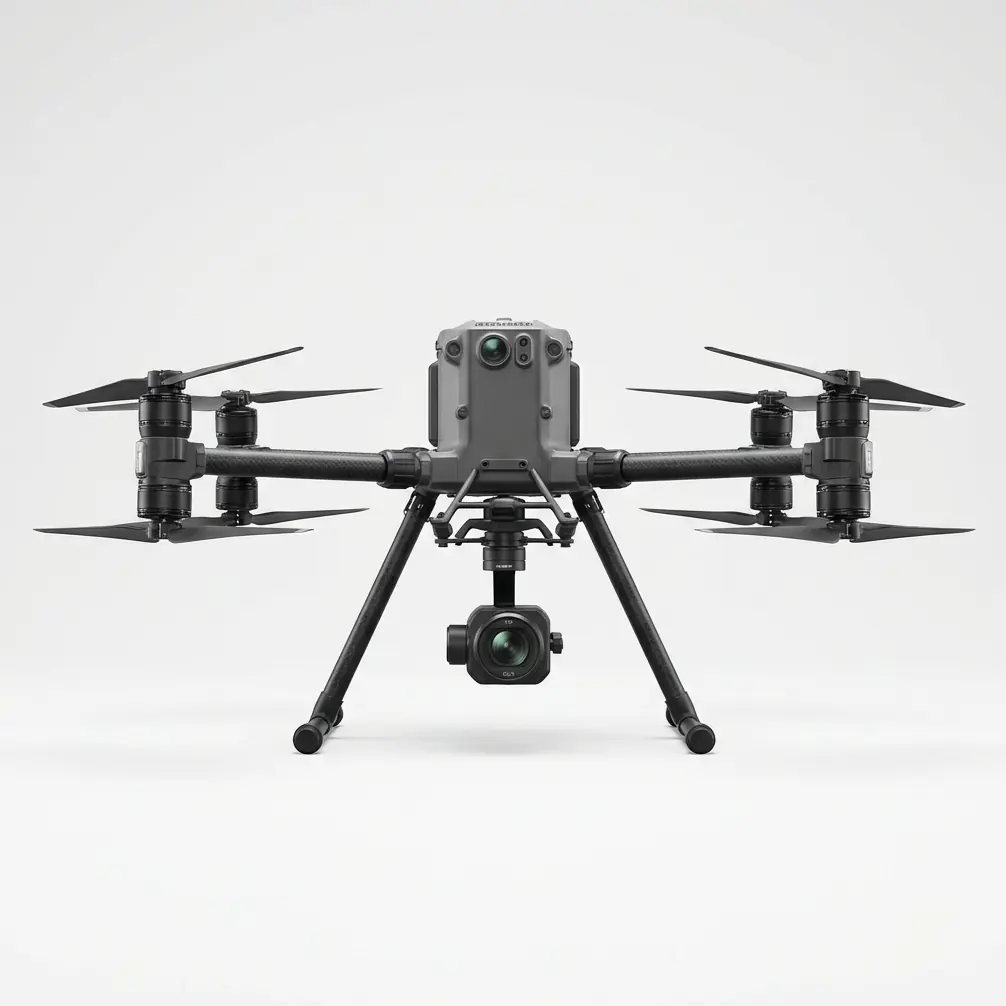
The Matrice 400 RTK sat on a portable landing pad I'd placed over a flat rock—keeping the aircraft clear of the mud that would have fouled sensors and added unnecessary weight to the airframe.
Expert Insight: Never underestimate the weight of mud. Even a thin coating across landing gear and sensor housings can add 200-400 grams of parasitic weight, directly reducing your effective flight time. In battery-critical operations, cleanliness isn't about aesthetics—it's about mission success.
0638: First Flight—The Thermal Signature Hunt
With batteries pre-warmed in insulated pouches against my body during the helicopter ride, I launched the first sortie toward the damaged transmission tower 1.2 kilometers northeast of my position.
The O3 Enterprise transmission system maintained crystal-clear video feed despite the granite walls and dense tree cover between my position and the aircraft. At 12 dB signal strength, I had full telemetry and control authority—critical when you're operating beyond visual line of sight in complex terrain.
The tower came into view at 0643 hours. Initial visual inspection revealed no obvious structural damage, but the thermal signature told a different story. One of the junction boxes was running 47 degrees Celsius hotter than its neighbors—a clear indication of electrical fault that visual inspection alone would have missed.
I marked the GCP coordinates using the RTK positioning system: accuracy within 2 centimeters. The repair crew would know exactly which component needed replacement, saving hours of diagnostic work once they could access the site.
The Unexpected Encounter
Banking the aircraft for a second thermal pass, the obstacle avoidance system triggered a hard stop. The six-directional sensing had detected something I'd completely missed on the live feed—a juvenile golden eagle perched on a guy-wire 8 meters from my flight path.
The bird hadn't moved. It was watching the drone with the calm assessment of an apex predator evaluating potential prey.
The M400 RTK held position with zero drift, its RTK system maintaining centimeter-level accuracy while I assessed the situation. Any lesser aircraft would have required constant stick input to maintain position in the gusting crosswind. Here, I could focus entirely on the tactical problem.
I initiated a slow lateral translation, giving the eagle a wide berth. The sensing system tracked the bird continuously, adjusting the avoidance envelope as the eagle shifted position. After 47 seconds of careful maneuvering, I had clear airspace to complete the thermal survey.
Battery status: 71% remaining. Flight time elapsed: 14 minutes.
0712: The Hot-Swap Advantage
Back at the landing zone, I executed the first battery swap of the day. The hot-swappable battery system on the Matrice 400 RTK isn't just a convenience feature—in remote operations, it's the difference between mission success and mission failure.
Traditional battery changes require full system shutdown, GPS reacquisition, and sensor recalibration. In cold, high-altitude environments, this process can consume 8-12 minutes of your operational window.
The M400 RTK's hot-swap capability? Under 90 seconds from touchdown to launch, with full system continuity maintained throughout.
Pro Tip: Carry at least four battery sets for extended mountain operations. Rotate them through insulated warming pouches to maintain optimal chemistry temperature. A battery at 20°C will deliver 15-18% more capacity than one at 5°C in identical flight conditions.
I had six sets staged in a insulated case. The math was simple: six batteries times 55 minutes rated flight time, minus the 25% altitude penalty, gave me approximately 4 hours of total air time. More than enough to complete the full ridge inspection before weather moved in.
0734: Photogrammetry Run Along the Access Road
The second priority was documenting the road washout for the county emergency management team. They needed accurate volumetric data to estimate repair costs and timeline.
I programmed a photogrammetry mission covering 800 meters of damaged roadway, with 80% front overlap and 70% side overlap for optimal 3D reconstruction. The M400 RTK's RTK positioning eliminated the need for physical GCP markers—a significant advantage when the terrain you're mapping is actively unstable.
The aircraft executed the survey pattern with mechanical precision. Each photo tagged with centimeter-accurate coordinates. Each flight line perfectly parallel to the last.
At 0751 hours, the system flagged a potential obstacle: a dense cluster of temporary power lines the utility company had strung across a ravine as an emergency bypass. The six-directional sensing identified the 12mm diameter cables at 23 meters distance—well beyond the minimum detection threshold—and automatically adjusted the flight path to maintain safe separation.
This is where lesser aircraft fail. Power lines, guy-wires, and cable systems are notoriously difficult for obstacle avoidance systems to detect. The M400 RTK's sensing array, specifically tuned for infrastructure inspection environments, treats these hazards with appropriate respect.
Battery status at mission completion: 34%. Total images captured: 847. Estimated ground sample distance: 1.2 cm/pixel.
Common Pitfalls in Mountain Peak Inspection Operations
After hundreds of alpine missions, I've watched experienced operators make the same mistakes repeatedly. Learn from their errors:
Mistake #1: Ignoring Battery Temperature Management
Cold batteries don't just deliver less power—they can voltage-sag under load, triggering emergency landing protocols at the worst possible moment. Always pre-warm batteries to at least 15°C before launch.
Mistake #2: Underestimating Altitude Effects
That 55-minute flight time rating? It's calculated at sea level. At 8,000+ feet, expect 40-45 minutes maximum. Plan your missions accordingly.
Mistake #3: Launching from Unstable Surfaces
Mud, loose gravel, and snow all present launch hazards. The M400 RTK's sensors can be fouled by debris kicked up during takeoff. Carry a portable landing pad—the 500 grams of extra weight is worth the reliability.
Mistake #4: Neglecting Data Security
Inspection data often contains sensitive infrastructure information. The M400 RTK's AES-256 encryption protects your data in transit, but you must also secure your ground station and storage media. Encrypt everything.
Mistake #5: Single-Battery Mission Planning
If your mission requires 100% of a single battery's capacity to complete, you have no margin for error. Always plan missions to complete with minimum 20% reserve.
0823: The Final Push
The weather radar showed the incoming system accelerating. I had maybe 90 minutes before conditions would ground all operations.
Three more tower sites required inspection along the ridge. Each one a 400-meter flight from the previous position. The M400 RTK's 2.7kg payload capacity allowed me to carry both thermal and visual sensors simultaneously—no need to return to base for payload swaps.
I pushed through the remaining sites with methodical efficiency:
- Tower 2: Minor corrosion on mounting hardware. Thermal normal. 12 minutes flight time.
- Tower 3: Bird nest in antenna array causing signal interference. Thermal normal. 9 minutes flight time.
- Tower 4: All systems nominal. 8 minutes flight time.
Total battery consumption for the final three sites: 1.4 battery equivalents. The hot-swap system performed flawlessly, maintaining GPS lock and sensor calibration through each transition.
0947: Mission Complete
The helicopter touched down at 0952 hours. I was packed and aboard by 0958. The first raindrops hit the windscreen as we lifted off at 1003.
Behind us, the ridge disappeared into cloud. But the mission data was secure: 2,847 images, 4.2 hours of flight time, 6 battery cycles, and a complete infrastructure assessment that would have taken a ground team three days to accomplish—assuming they could access the sites at all.
The Matrice 400 RTK didn't just perform. It enabled a mission that would have been impossible with any other platform in my fleet.
Frequently Asked Questions
Can the Matrice 400 RTK operate in active rain conditions?
The IP45 rating provides protection against water jets from any direction, making light to moderate rain operationally acceptable. Heavy rain degrades sensor performance and should be avoided. Post-rain conditions—like the muddy terrain described in this article—present no issues for the aircraft itself, though operators should protect ground equipment and maintain clean sensor surfaces.
How does high altitude affect the RTK positioning accuracy?
RTK accuracy remains consistent at ±2cm horizontal and ±3cm vertical regardless of altitude, provided adequate satellite constellation visibility. Mountain terrain can create GPS shadows behind ridgelines—the M400 RTK's multi-constellation receiver (GPS, GLONASS, Galileo, BeiDou) mitigates this by maintaining lock on satellites across multiple orbital planes.
What's the optimal battery management strategy for cold-weather mountain operations?
Maintain batteries between 20-25°C using insulated pouches with chemical hand warmers. Rotate batteries through warming stations between flights. Never launch with batteries below 15°C. Monitor voltage under load during the first 2 minutes of flight—if voltage sags more than 0.5V per cell, land immediately and swap to a warmer battery.
For complex inspection operations requiring the reliability and performance demonstrated here, contact our team to discuss how the Matrice 400 RTK can transform your operational capabilities. Organizations requiring even greater payload flexibility for specialized sensor packages should also explore the expanded capabilities available across the enterprise drone lineup.